
Every owner I talk to asks the same question in the first ten minutes. Will it pay for itself? It’s the right instinct and the wrong framing, and once you flip it the whole decision gets simple.
Here’s the flip. You’re already paying for this employee. You’re paying in the calls that ring out while you’re on a job, the leads that go cold before you get back to your desk, the appointments that quietly evaporate on a Tuesday morning. That bill comes due every week. It just never shows up on an invoice, so it’s easy to pretend it isn’t there.
An AI employee doesn’t add a new cost you have to earn back. It stops one you’re already absorbing. That’s the argument, and it holds for almost any service business, because the leaks are the same everywhere. Let me walk the three that cost the most.
The Bill That Never Shows Up on an Invoice
Start with the phone. Across small businesses, only about 38% of incoming calls get answered by a live person. The rest split between voicemail and dead air, which means roughly 62% of calls go unanswered.
Now the part that turns a missed call into lost money. 85% of the people who don’t get through won’t call back, and 62% of callers who can’t reach you go straight to a competitor. A missed call isn’t a message you’ll return later. It’s a customer who already hired someone else by lunch.
For a home-services shop or a clinic where one job is worth hundreds or thousands, a handful of ignored calls a week is a real salary walking out the door. We took one apart in the call that came in at 9:47 pm.
An AI employee answers every one of those, at 2 in the afternoon and 2 in the morning, and it never sends anyone to voicemail.
Speed Is the Whole Game
Even the calls you do catch have a clock on them. The MIT Lead Response Management study found that 78% of customers buy from the first business that responds. Not the cheapest, not the most reviewed. The first.
The window is smaller than most owners think. Answer a new lead within five minutes and you’re 100 times more likely to reach that person than if you wait thirty. Harvard Business Review’s study of online sales leads put the same truth another way: lead quality drops about 80% once the first five minutes pass.
No human running a business can hit five minutes every time. You’re under a sink, in a chair, in a meeting. The average company takes 47 hours to answer a lead. An AI employee replies in seconds, all day, and that alone decides who wins the job. There’s more on that in five minutes or it’s cold.
The Empty Chair
The third leak is the one owners feel in their gut but rarely add up. No-shows. Depending on the specialty they run anywhere from 10% to 30% of booked appointments, and even a well-run practice loses close to one in five.
An empty slot isn’t a gap you fill later. It’s revenue for that hour that can’t be recovered, on top of staff you paid to sit and wait. The fix is boring and it works: confirmations, reminders, and a one-tap way to reschedule before the slot is gone. An AI employee sends every one of those without being asked, then backfills the hole from the waitlist. We walked through it in the chair that sat empty.
Why This Is True for Everyone, Not Just Big Firms
Notice these aren’t three separate problems. They’re one. Every one of them is a front desk nobody is staffing around the clock, because no small business can afford to.
That’s why the ROI generalizes. A plumber, a dermatology clinic, a law office, an accounting practice run different businesses, but they all lose money the same three ways. The lead that isn’t caught. The answer that comes too late. The seat that sits empty. Fix the front desk and you close all three at once.
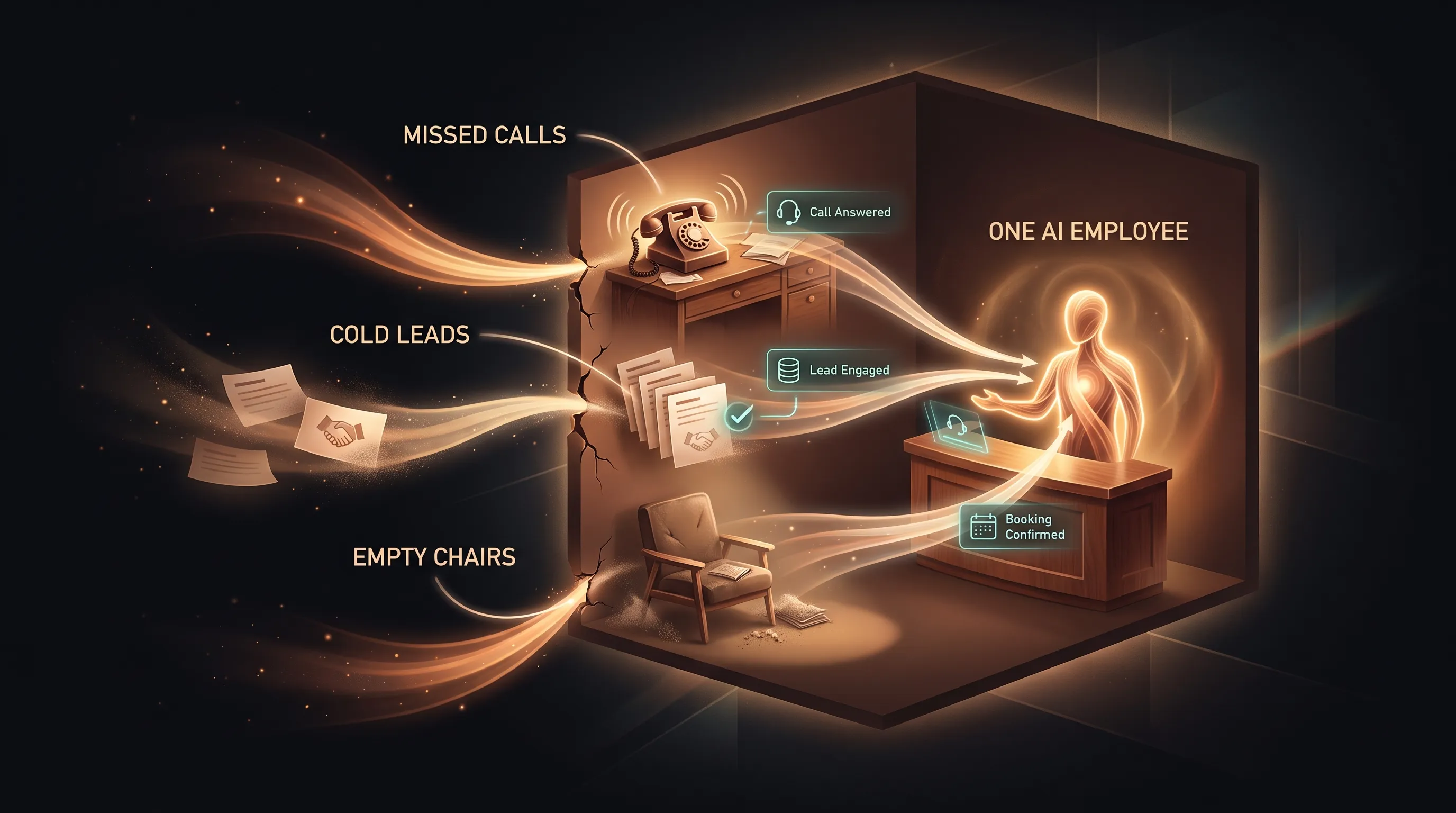
The size of the leak scales with the business. The leak itself is universal. That’s the whole reason a case that works for one appointment-driven shop works for the next one.
You Don’t Buy the Roster
Here’s where I part ways with how this usually gets sold. The industry loves to pitch a whole workforce: an AI receptionist and an AI sales rep and an AI scheduler and an AI reputation manager, ten hires at once, a full org chart overnight.
Don’t. You don’t need the roster, and buying it is how small businesses end up with ten things they can’t supervise and don’t trust. Start with the one role where your loss is biggest. For most owners that’s the front desk, because that’s where all three of these costs live. Get that one working, watch it for a month, then decide if there’s a second. We made this case at length in you don’t need 300 agents, and on how to choose the first job in which job do you hand to AI first.
The ROI Is Subtraction, Not Addition
That’s the reframe I want you to leave with. The math on an AI employee isn’t a bet on new revenue that may or may not arrive. It’s the recovery of money you’re already losing, every week, on autopilot.
You don’t have to trust a projection to see it. You just have to count the calls you missed last week, the leads that went cold, and the chairs that sat empty, then ask who’s covering those right now. The answer is you. We wrote about what we actually track in the ROI we actually measure.
The employee you haven’t hired is already on the payroll. You’re just not getting any of the work.