
Aaron Levie, the CEO of Box, told investors on a recent earnings call that enterprises are heading toward a world with “hundreds of times more agents than people.” Software agents outnumbering staff a hundred to one, maybe a thousand to one, each one reading data and moving work on its own. Agents, he said, will become the largest user of software and data inside a company.
I run a company that builds AI employees. You’d think that would be my favorite prediction of the year. It isn’t.
The Fortune 500 Has a Different Problem Than You Do
Levie is describing his own customers. Box sells to enterprises with thousands of employees and oceans of files, and in that world an army of agents makes sense. When you have 40,000 people and ten thousand folders nobody has opened since 2019, you need something that can read all of it at once.
A founder-led firm is the opposite of that. Six people. One inbox that actually matters. A dozen processes that repeat every single week. You don’t have a governance problem waiting to be solved by a hundred agents. You have a Tuesday that opens with 30 unanswered emails and a proposal you forgot to follow up on.
Pointing 300 agents you can’t supervise at that day isn’t leverage. It’s a second job.
What Box Quietly Admitted
Here’s the part of the buzz nobody’s reading closely. In the same stretch, Box published its 2026 State of Enterprise AI report, and the headline finding reads like a confession: 90% of IT leaders say security, regulatory, and trust concerns are the biggest barrier to letting agents touch their content.
Read that again. The company selling the agent future is telling you its own buyers are afraid to switch it on.
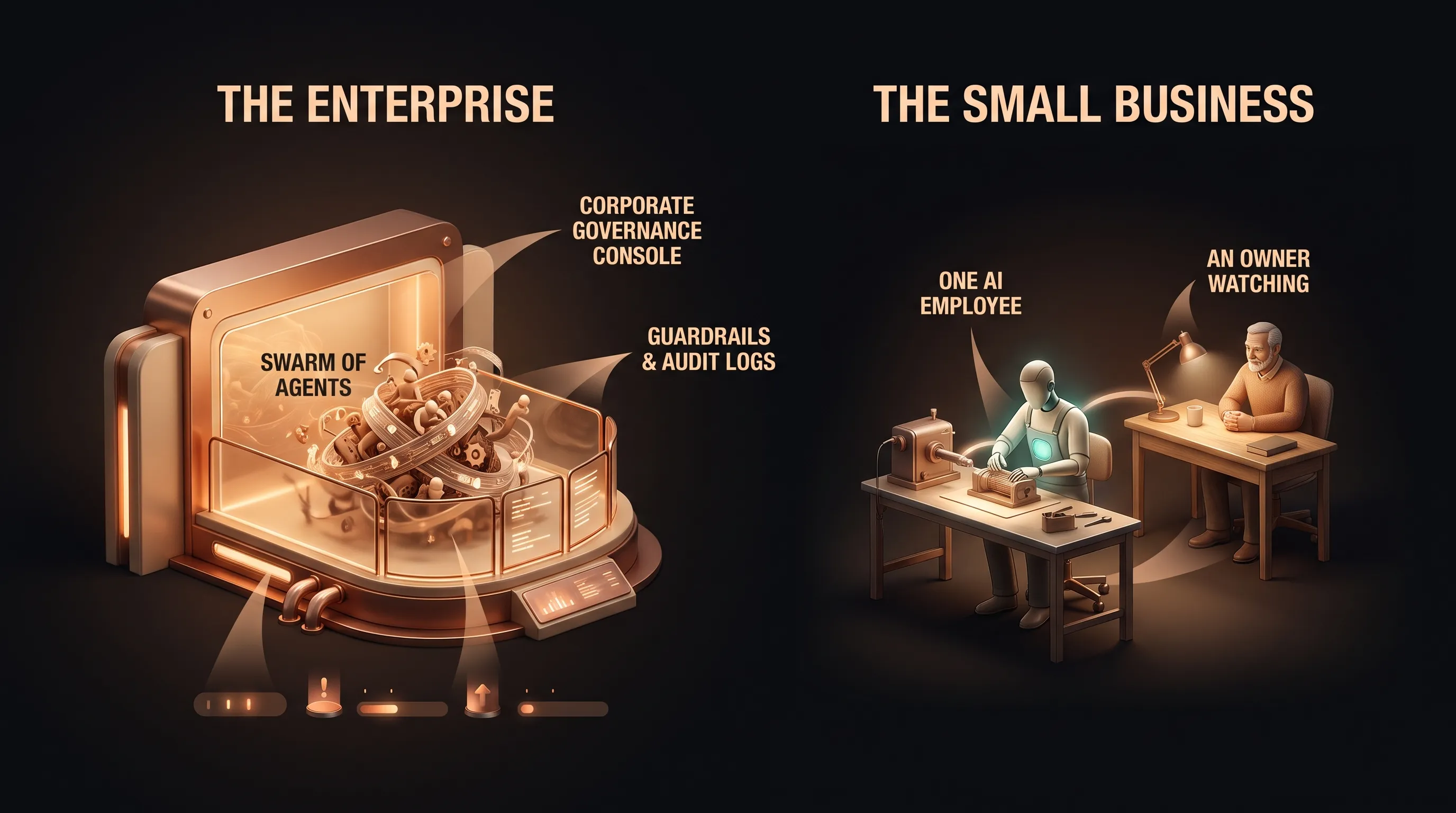
So Box does what enterprises do. It builds a control layer — prompt-injection detection, approval gates, audit trails, and an activity console that fires alerts. That’s the right answer at their scale. Governing a thousand agents takes a thousand-agent governance system.
But that entire apparatus exists to solve a problem you don’t have.
Trust You Can See Without a Dashboard
At a six-person company, trust doesn’t come from an audit log. It comes from scope.
One AI employee. One defined job: answer every inbound lead in minutes and book the call. One human who owns it and can read exactly what it did this morning over coffee. When the work is narrow and the owner is watching, you don’t need a console to trust it. You can just look.
That’s the real difference between an agent and an AI employee. An agent is a raw capability you point at your data. An AI employee is a role with a boundary, a job description, and a person accountable for it. (If that line still feels fuzzy, we wrote a whole field guide on what a managed AI employee actually is.)
You’re not governing a swarm. You’re supervising one hire. That’s a problem a busy founder already knows how to solve.
The Part Levie Gets Right
Strip away the enterprise framing and there’s a real insight underneath his pitch. His bigger argument is that AI takes capabilities that used to be scarce and expensive and makes them cheap and available. He’s picturing a bank. I keep picturing the three-person shop that never had those capabilities at all.
The enterprise already had the analyst, the overnight answering service, the ops person chasing down missing documents. Cheaper capability just gives them more of what they had. The small business never had any of it. So when the scarce thing gets cheap, the gain doesn’t land evenly. It lands hardest on the people who were priced out of it entirely.
That’s the opportunity I actually care about. Not three hundred agents for a company that has three hundred of everything already. One reliable AI employee for the founder who’s been doing the work of three people and can finally hand one of those jobs off.
You don’t need the swarm. You need the first hire to show up and do its job. We’ll take it from there.