
The first question almost every owner asks is some version of “will this let me replace someone?” It’s an honest question, and it’s the wrong one. Not because the answer is uncomfortable, but because it measures the wrong thing.
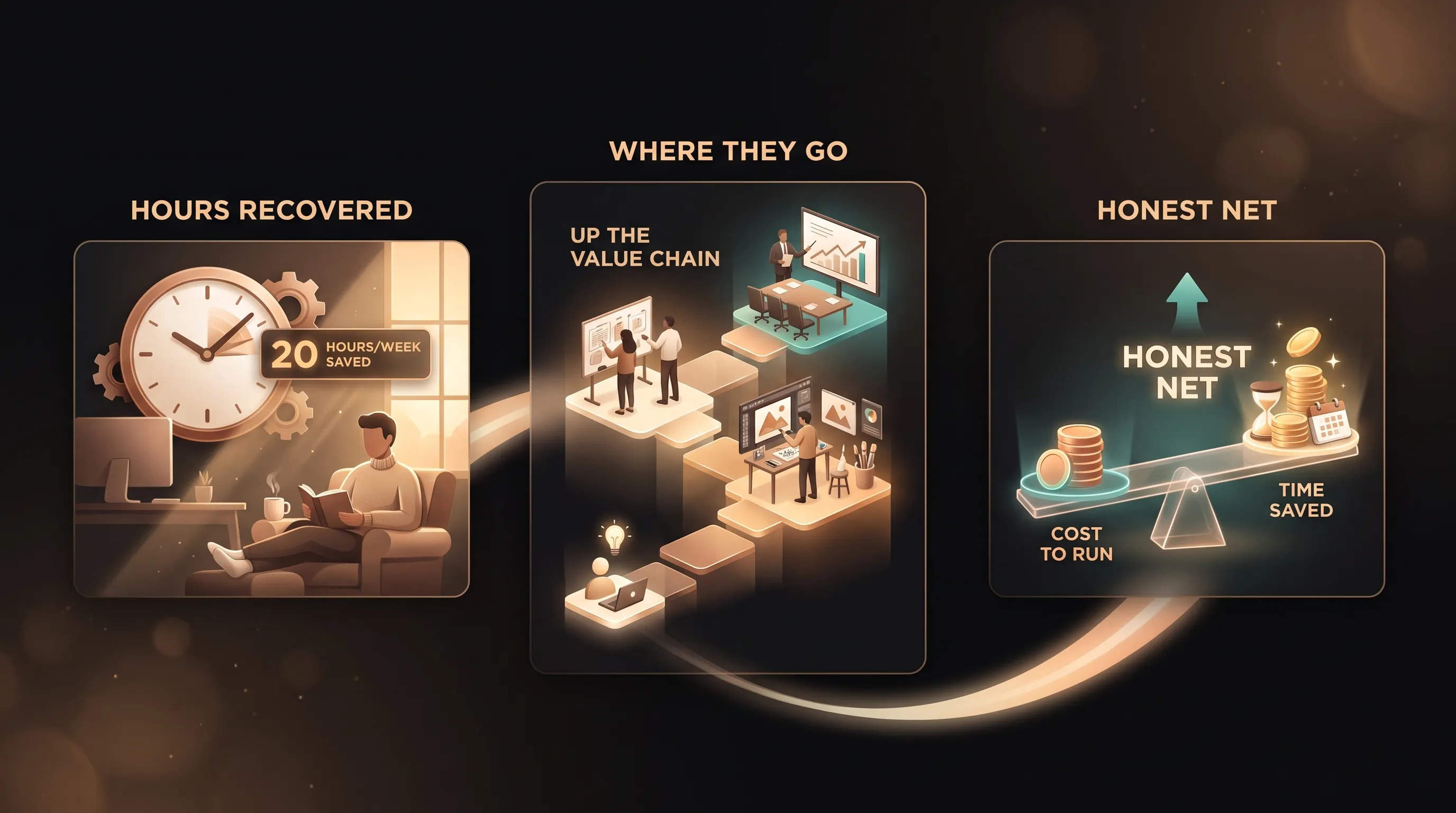
An AI employee’s real return isn’t a smaller team. It’s the same team spending its hours on work that actually deserves them. So when we talk ROI, we don’t lead with headcount. We measure three things, and they’re the same three we’d want to see before spending a dollar on anything.
One: hours recovered per week
The first number is the most concrete. How many hours a week does this job eat right now, across everyone who touches it?
Count them honestly and the figure is usually bigger than anyone expects, because the work is scattered. The intake calls, the follow-ups, the chasing, the copying between systems. No single person feels it as a full day, so nobody adds it up. When you do, a repeating admin job routinely turns out to cost a small team ten to twenty hours a week.
That’s the number an AI employee moves, and it’s measurable from day one. You knew what the week looked like before. You can see what it looks like after. If the hours don’t drop, the project didn’t work, and we’d rather that be obvious than hidden.
Two: where those hours go
Recovered hours only matter if they land somewhere valuable. So the second number is what the freed time gets spent on.
This is where the “replace someone” frame falls apart. The hours an AI employee gives back don’t disappear from the payroll, they move up the value chain. The paralegal stops chasing intake calls and gets back to case work. The principal stops reviewing the RFI log at 9pm and gets back to design and clients. The senior person you can least afford to lose to admin stops losing their week to it.
That shift is the actual product. You’re not buying a cheaper version of the same output. You’re moving your most expensive people off your least valuable work, which is the opposite of what happens when a business gets busy and everyone drowns in the small stuff.
Three: the honest net
The third number is the one most providers skip: does the math actually work?
Put the recovered hours, valued at what that time is really worth to the business, against what the AI employee costs to run. If the first is bigger than the second, you have a return, and usually a large one once the setup is behind you. If it isn’t, you should hear that from us before you commit, not discover it a quarter in.
We built that honesty into our assessment on purpose. The report ends with the financial picture, including the moves where the numbers don’t justify the effort, because a return you can’t see is a return you won’t trust. There’s more on how we lay that out in we’ll even tell you what to ignore.
Why measurable jobs win
Notice that all three numbers depend on picking a job you can actually measure. That’s not a coincidence, it’s why we push owners toward measurable first projects so hard.
When Aria took over an architecture firm’s RFI log, the return wasn’t a feeling that things ran smoother. It was a specific figure: around $1,080 of administrative cost per RFI, multiplied by a hundred RFIs a project, turned from days of turnaround into same-day answers. You can argue with a vibe. You can’t argue with that.
So if you take one thing from how we think about return, let it be this. Don’t measure an AI employee by whether it shrinks the team. Measure it by the hours it hands back, where those hours go, and whether the net is honestly positive. Get those three right and the headcount question answers itself, usually in the direction of a team that finally has room to grow.