
Every owner I talk to gets stuck on the same question. Not “should we use AI” — most of them are past that. It’s “where do we even start?” There are a hundred things AI could touch in a business, and the size of that list is exactly what keeps people from touching any of it.
So here’s the honest answer we give, and it’s narrower than people expect. Don’t start with the job that sounds most like the future. Start with the one that repeats, runs on rules, and hurts when it slips.
Flashy is the wrong filter
The instinct is to reach for the impressive use case, the one that would make a good story at a conference. Strategy. Creative work. The judgment calls only you can make.
That’s almost always the wrong first job, for a simple reason: impressive and repeatable are rarely the same thing. The work that defines your business is usually the work that’s hardest to hand off, because it lives in your head and changes every time. Handing that off first means a long, frustrating setup and a result you don’t trust. People try it, it disappoints, and they conclude AI “isn’t there yet.”
It was there. They just aimed it at the hardest possible target on day one.
Four questions that sort it fast
When an owner asks us what to hand off first, we run the candidate jobs through four questions. The best first job answers yes to all four.
- Does it repeat? Same shape, many times a week. An intake call, an invoice, a follow-up email, a scheduling back-and-forth. Repetition is what an AI employee is built for, and it’s what makes the work worth setting up once.
- Can you feel it when it slips? The best first jobs have a visible failure. A missed call is a lost client. A late follow-up is a dead lead. If nobody notices when the job goes undone, it’s the wrong place to prove the point.
- Does it run on rules, not taste? There should be a right way to do it that you could write down. Not “it depends on my mood that day” but “if this, then that.” Rules are teachable. Taste is much harder, and it’s not where you want to start.
- Can you put a number on it? Hours a week, dollars a month, leads per quarter. If you can measure the job today, you can measure whether the AI employee actually moved it. A first project you can’t measure is a first project you’ll argue about later.
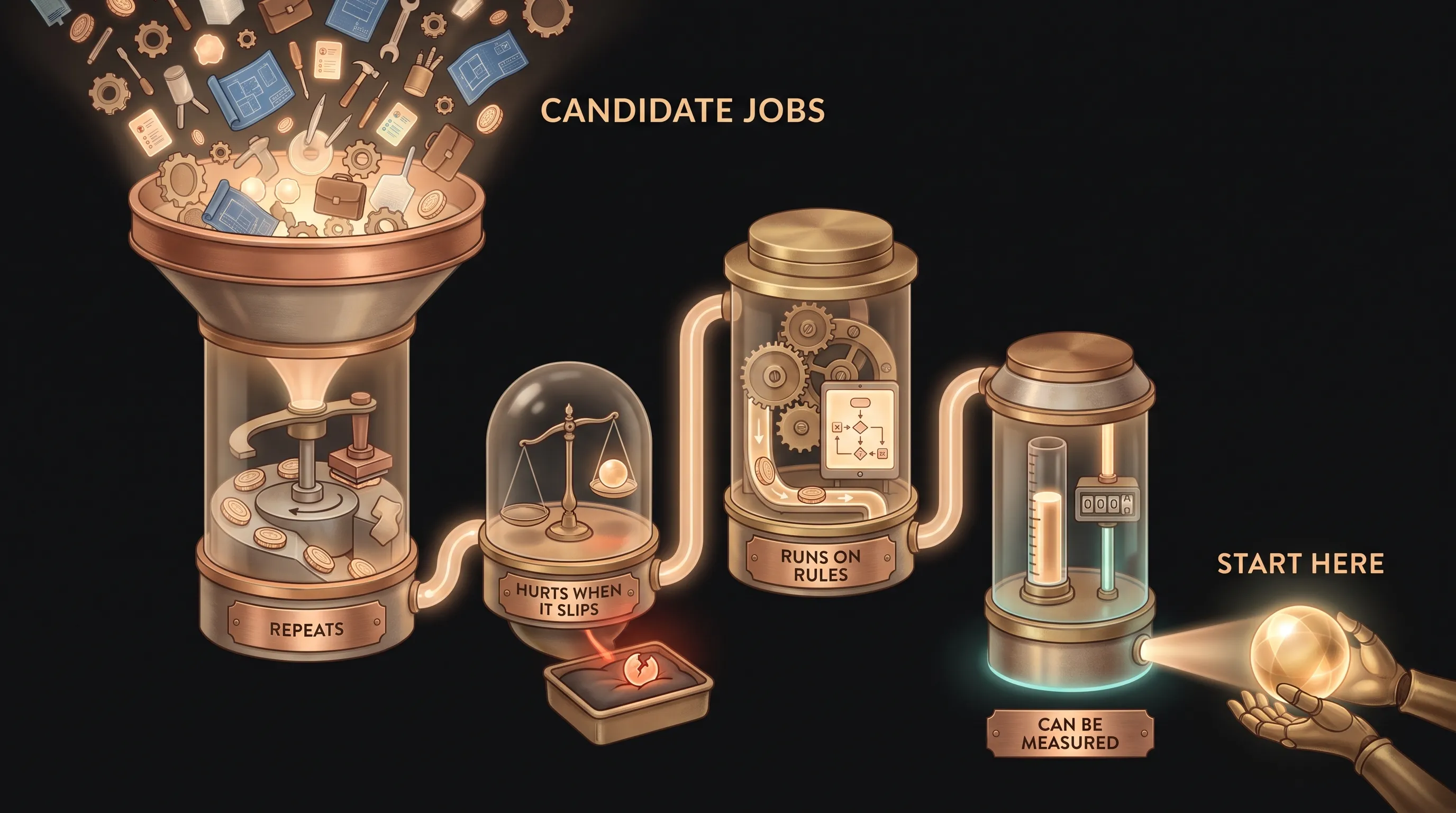
Start where the loss is visible
Notice what those four questions point at. Not the exciting work. The boring, bleeding work.
For a law firm, that’s usually intake, because a dropped call is a case walking to the firm down the street. We wrote about exactly that in the lead you never knew you lost. For an architecture firm, it’s the RFI and submittal log, because you can put a real dollar figure on every question that sits in an inbox. For most other businesses it’s scheduling, follow-up, or the pile of small admin that quietly eats the week.
None of those are glamorous. All of them repeat, run on rules, hurt when they slip, and can be measured. That’s the whole point. You want your first AI employee working on something where a good result is obvious to everyone, because the first win is what earns the budget and the patience for the harder projects later.
The order matters more than the ambition
The mistake isn’t picking the wrong job forever. It’s picking a hard one first, getting burned, and never getting to the easy wins that would have paid for everything.
So we tell owners to invert the usual instinct. Start narrow, start measurable, start where it already hurts. Get one repeating job off your team’s plate and running cleanly for a few weeks. Then use what you learned, and the hours you got back, to go after the bigger, messier work that actually defines the business.
If you want that sorting done for your specific business rather than in the abstract, that’s what a good assessment is for. We built ours to place every opportunity on impact against effort and tell you which one to start with, including the moves we think you should skip. There’s more on how that works in we’ll even tell you what to ignore.
The first job isn’t the one that impresses. It’s the one that finally stops costing you quietly.