
It’s 9:47 on a Tuesday night and a homeowner’s water heater just failed. They pick up the phone and call the first company they find. If it rings out to voicemail, they don’t leave a message. They call the next name on the list, and whoever answers gets the job.
That call was worth real money, and most home-services businesses never know it came in. The numbers are blunt about how often it happens. Across the trades, 27% of inbound calls go unanswered, and of the callers pushed to voicemail, fewer than 3% leave a message. They just hang up and dial the competition. Invoca puts the average cost of a single missed call at about $1,200 in lost revenue. So let’s walk through that 9:47 call the old way, then what changes when an AI employee answers it.
The old way
The phone rings at 9:47. Here’s the next twelve hours:
- Everyone’s off the clock. The call rolls to voicemail, or to an answering service that takes a message and can’t book anything.
- The homeowner doesn’t wait. They’re standing in a puddle. They hang up and call the next company, which picks up and wins the job.
- Your voicemail light blinks, except it doesn’t, because they never left a message.
- At 7 the next morning, the office starts returning yesterday’s missed calls. Half have already booked elsewhere.
- Nobody tallies the ones that got away, because there’s no report for the job that never became a job.
Every step is understandable. Nobody can answer the phone at midnight, and returning calls at 7am is a reasonable plan. But a plan that loses the caller before you call back isn’t really competing for the after-hours work at all.
The AI employee way
Same 9:47 call, except the business has an AI employee named Theo answering the phones. Theo has read the company’s Business Brain, so he knows the service area, the trades and job types, the service tiers, the on-call rules, and what counts as an emergency.
Here’s the same night:
- The phone rings and Theo answers on the first ring, at 9:47pm or 3am, in the company’s voice.
- He asks the qualifying questions a good dispatcher would: what’s failing, how urgent, what address, are they inside the service area.
- A true emergency, no heat in winter, water actively leaking, he escalates to the on-call tech right then with the details already gathered.
- Everything else he books straight into the schedule for the morning, and sends the homeowner a confirmation so they stop shopping.
- The whole call is logged in the system, so the office opens to booked jobs instead of a list of numbers to chase.
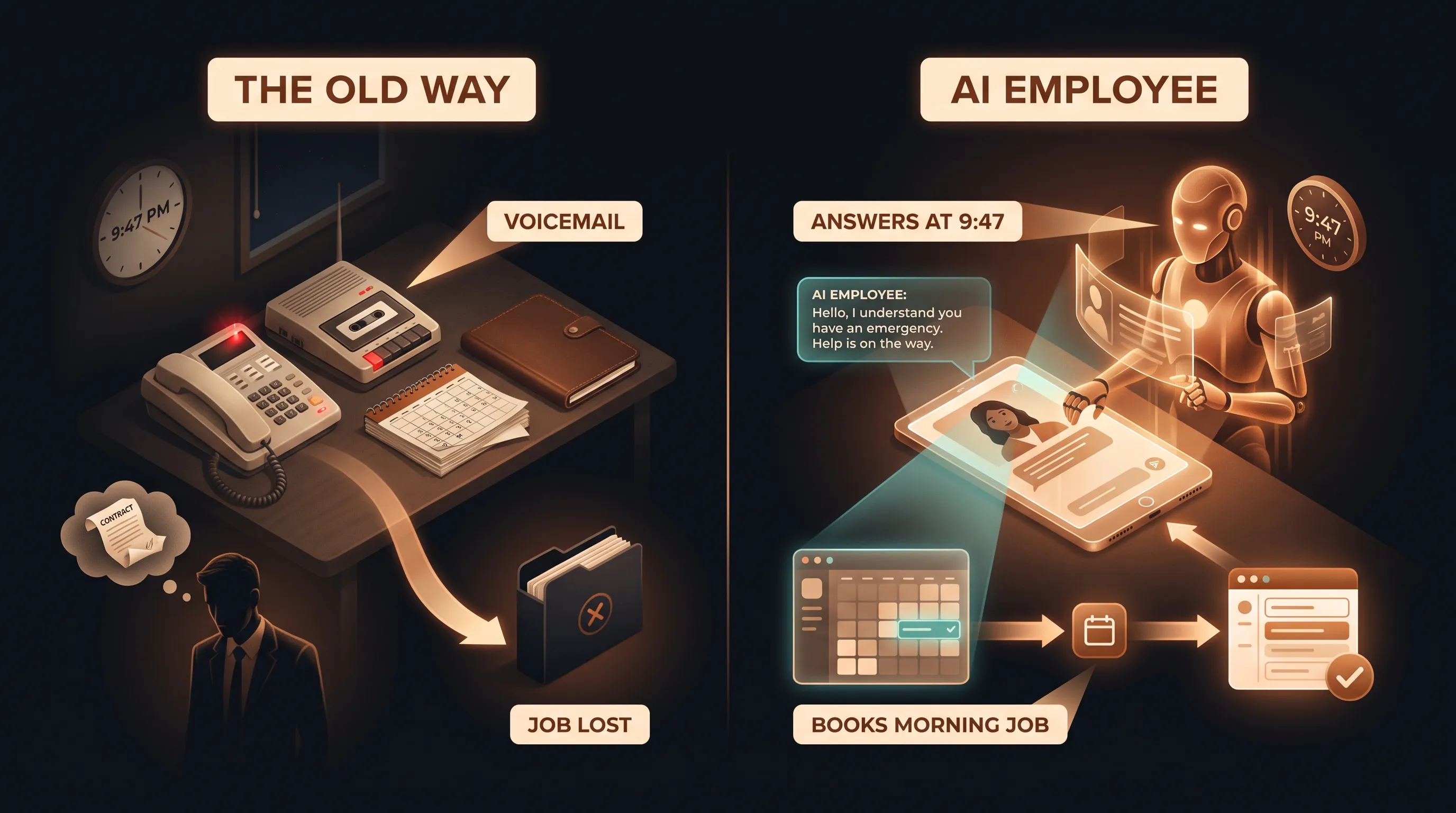
The caller never hits voicemail. The job never walks to the company down the road. And the crew wakes up to a schedule that filled itself overnight.
Why the tools you tried didn’t do this
Plenty of shops have tried an answering service or a generic call helper. It took messages nobody could act on, or it read a script that didn’t know the service area or the difference between a clogged drain and a flooded basement. So it didn’t book anything, and everyone went back to voicemail.
Theo works because of what sits behind him: a Business Brain built from how your company actually runs. That’s the piece the answering service was missing. It’s also why he gets sharper each week, learning your emergency rules and your booking patterns until he triages a late-night call the way your best dispatcher would.
Answering the phone is the right place to start for one plain reason: you can put a dollar figure on every missed call. An HVAC repair averages around $350 and a plumbing repair about $340, before you count the repeat work a new customer brings over the years. Answer every call, book the ones you can, and triage the rest, and the phone stops quietly handing your after-hours revenue to whoever picks up second.