
You have read your own brief so many times you can’t see it anymore. The hole a first-year on the other side will drive through in about four minutes, you stopped noticing three drafts ago. That blind spot is the most expensive thing in the building.
The value of an AI employee in a law firm isn’t that it writes the brief faster. It’s that it asks the question you stopped asking.
The draft is the easy part
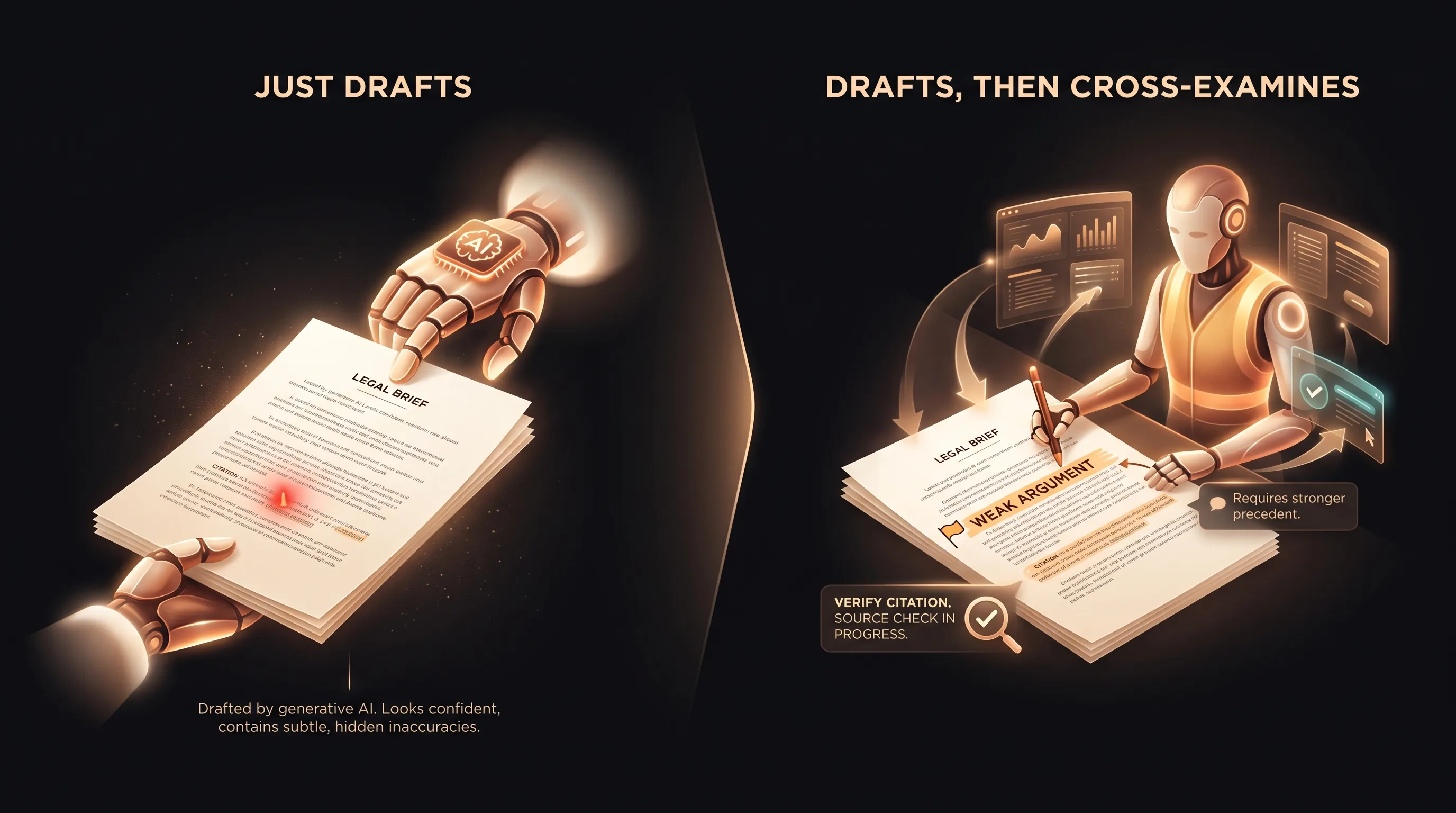
The pitch everywhere is “AI writes your motion in seconds.” That’s the least useful thing it can do, and quietly the most dangerous. A model built only to produce will hand you a clean, confident document with a case that doesn’t exist buried on page six. There is now a public database tracking court decisions where someone filed AI-invented citations, and it lists more than 2,000 cases and counting. Every one of them started as a draft that nobody cross-examined.
So speed on the first draft is the wrong thing to buy. The draft was never the hard part of lawyering. The hard part is the read after the draft, the one where you argue against your own work before a judge does it for you.
An employee that argues back
Clerko drafts. Then it does the other half of the job, the half the market forgot to sell. It reads the draft the way opposing counsel will: where’s the unsupported leap, which citation doesn’t say what the sentence claims it says, what’s the strongest version of the other side’s response, and does the brief actually answer it. Every citation comes back flagged for you to verify, not asserted as fact.
That’s a different kind of help than a faster first draft. It’s a harder second read, the one your sharpest partner does when there’s time, except there’s never time. An AI employee that only writes will never give you that read. One built to challenge gives it to you on every matter, at 6 p.m. on a Friday, when the partner has gone home.
You still decide, it just makes you decide better
None of this moves judgment off your desk. It sharpens the moment you use it. Clerko surfaces the weak point and the missing authority, and you decide what to do about them. Nothing files without your sign-off, because the whole design assumes the lawyer is the one accountable to the court.
That’s the same reason we tell firms you stay above the outcome instead of operating the machine yourself, and why the safest place to begin is the work you already check. The AI employee earns trust by making your review faster and sharper, not by asking you to skip it.
The question before you file is the one that saves the case. An AI employee that only writes will never ask it. One built to argue back asks it every time.