
You bought AI to get time back. Then you noticed your evenings filling up with a new kind of work: deciding what to hand it, writing out the context it needs, reading what it produced to see if it’s right, and pulling the plug when it wanders off. The work didn’t disappear. It changed shape.
That’s not a you problem. It’s the pattern everywhere right now, and it’s worth understanding before you buy your way deeper into it.
AI doesn’t subtract work. It multiplies it
Strategist Nate B. Jones lays out the evidence in a recent breakdown: agent usage on one major routing platform jumped 14-fold between February and August, and agents now burn roughly five times the tokens a human does. The heaviest users generate more than sixty hours of agent activity a day. Nobody watches sixty hours of anything.
So the premise flips. We build these things to take work away, and at every scale the evidence shows they hand us more. Someone still has to choose the jobs, feed the context, check the output, and take over when it fails. As Jones puts it, in 2026 people aren’t in the loop anymore — they’re above it.
”Above the loop” is a real job
That phrase sounds abstract until you add up the hours. Above the loop means you pick the work, start the runs, decide what can act without you, and judge which failures actually matter. It’s management. And management is a job, whether the thing you’re managing is a person or a piece of software.
Anthropic saw the split clearly when it studied around 400,000 Claude Code sessions: the human made about 70% of the planning decisions while the agent handled most of the execution. You decide what gets built and hand over the context; it does the doing. Knowing the problem mattered more than knowing how to do the task. That’s true for coding, and it’s just as true for running your intake or your follow-ups.
Here’s the catch for a small business. That 70% doesn’t shrink to zero as the models get better. A single agent needs less babysitting over time, but the volume of work climbs, so the steering never goes away. It just moves up a level. And the owner steering it is the same person who’s supposed to be running the actual business.
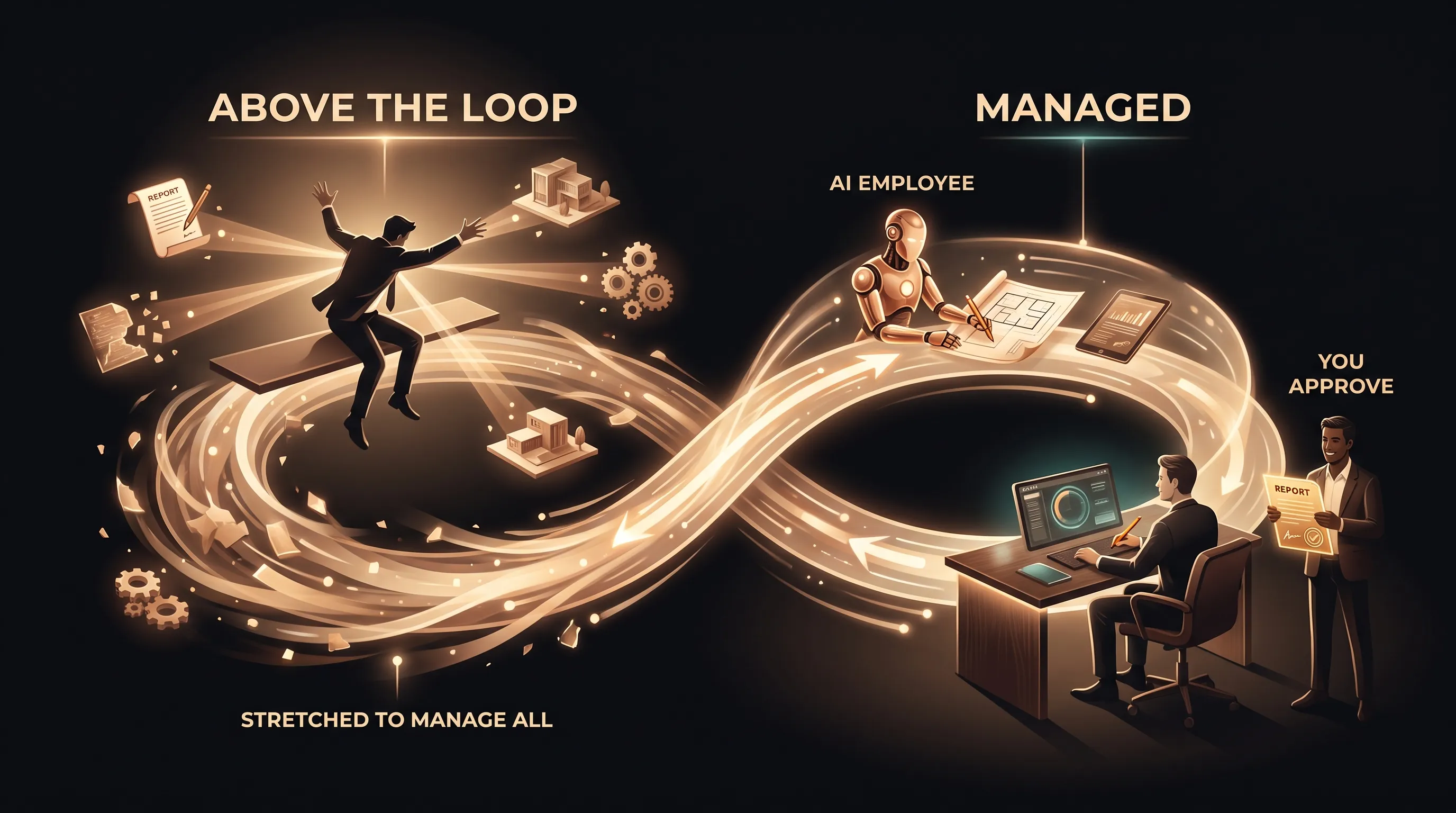
Managed means the steering isn’t yours
This is the whole reason we sell a managed AI employee, not a seat. The management tax is real — someone has to sit above the loop. The question is only who.
- We choose and wire the work. We find the job worth handing over, connect the AI employee to it, and write the context it needs to do it your way. You don’t become the operator.
- We watch the runs and catch the drift. Steering the swarm, judging which failures matter, stopping a bad run — that’s our job, not an owner’s evening.
- You keep the one decision that’s yours. A person on your team approves the output before it reaches a customer. You stay above the outcome without living above the loop.
The plumber didn’t get into plumbing to manage agents. Neither did the tax preparer or the clinic owner. Someone has to steer the thing — that part is not optional anymore. It just doesn’t have to be you, which is the same reason we tell owners you don’t need 300 agents. You need one you don’t have to babysit.