
Watch where AI is actually working, not where it’s being hyped, and a pattern jumps out. Legal is one of the fastest-growing places for agents right now — usage up roughly 108x since January, as strategist Nate B. Jones points out. Not because lawyers are early adopters. Because law is checkable.
A verifiable domain is one where you can cheaply prove the output is right or wrong. Coding took off for the same reason — the tests either pass or they don’t. Law is close behind: you’re either in line with the statute and the record, or you’re not. Where you can’t easily check the work, progress gets messy and stalls.
The checkable-work advantage
That’s a useful lens for a small business, because it tells you where an AI employee will actually land value first — and where it’ll flail.
The winning move borrowed from legal is simple: don’t invent a brand-new workflow. Let the AI do work you already have to review anyway. A small D.C. injury firm, Traubly and Singer, uses a service called Even Up to draft demand packages — and that one workflow saves about 40 staff hours a month, per Jones’s breakdown. The lawyers were already comparing each package against the case records. Checking the AI isn’t extra work for them. It’s the job they already had.
That’s the whole trick. The review was happening regardless. Putting an AI employee in front of it doesn’t add a step — it fills in the part that used to eat the hours, and leaves the part a human was always going to do.
Find the spot where you already review
Every service business has one of these. It’s the place where an owner or a senior person already looks something over before it goes out.
- The quote you check before it reaches the customer.
- The intake form someone reviews before the job is scheduled.
- The follow-up email a manager skims before it sends.
- The invoice that gets a second look before it’s billed.
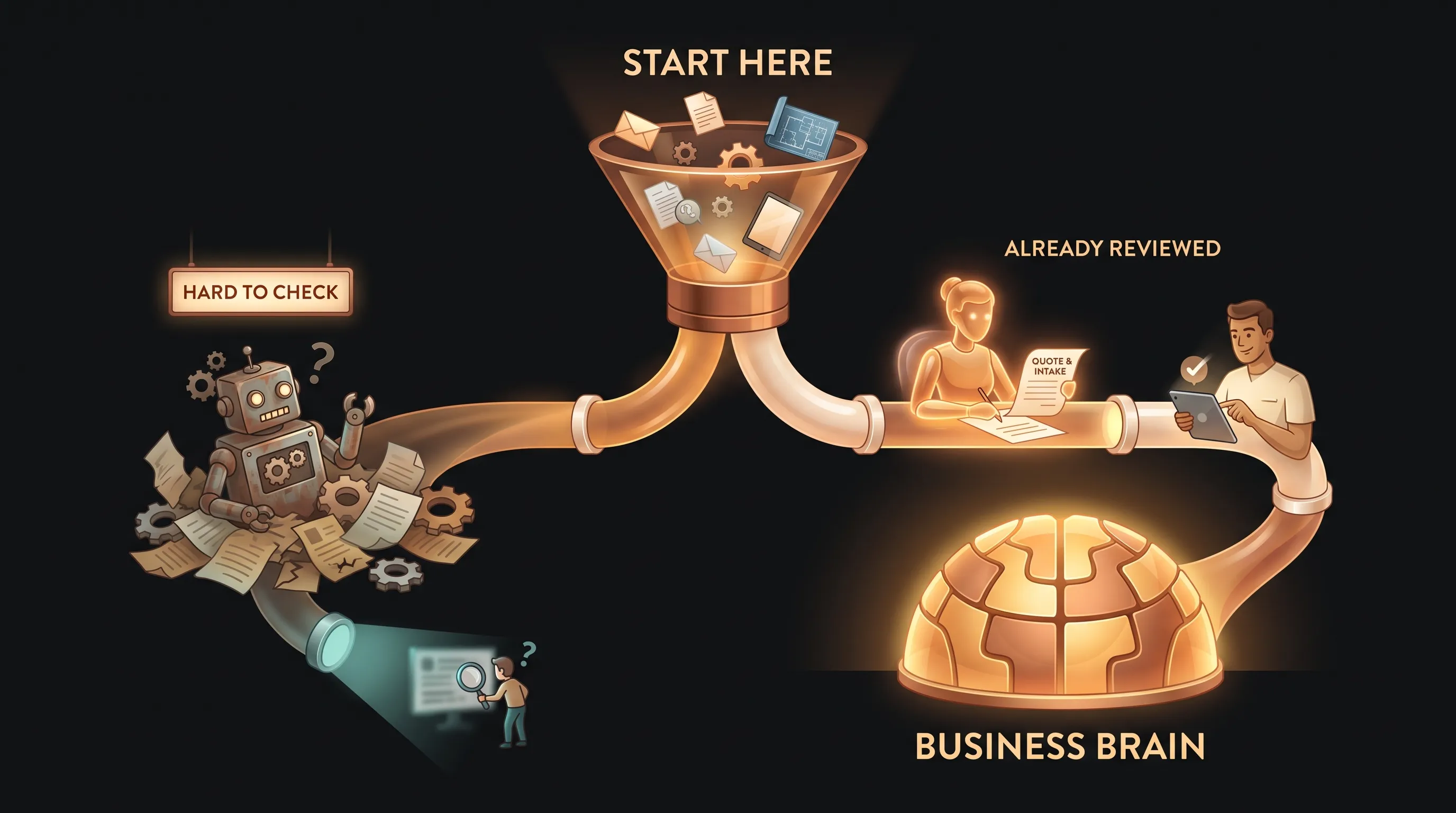
Each of those is a checkable moment. You already know what “right” looks like, and you’re already spending the seconds to confirm it. That’s exactly the work to hand over first — not the flashiest task, the one where your review is already built into the process.
Why this fits how we build
This is the logic behind a managed AI employee, not a coincidence with it. We don’t drop a general assistant in and hope you find a use for it. We look for the checkable work you already own.
- We put the AI on the review you already do. The draft comes from a Business Brain full of your quoting rules, your records, and your standards, so the version you check is already close.
- Your existing check becomes the safety net. The approval step isn’t new overhead — it’s the review that was already in your day, now catching an AI draft instead of a blank page.
- We start where it’s provable. Checkable work first means you can tell, fast, whether it’s actually saving you the hours. No leap of faith required.
The hard part of adopting AI was never the model. It was finding the spot where it pays off without becoming a second job. Start with the work you already double-check, and that problem mostly solves itself — which is really the same question we ask on day one: which job do you hand to AI first.