
This year everyone started writing the same memo. Jack Dorsey cut roughly 4,000 jobs at Block, about 40% of the company, and told the people who stayed that from now on the plan was “intelligence at the core of everything we do.” Fiverr’s CEO warned his staff that “AI is coming for your jobs. Heck, it’s coming for my job too.” Duolingo announced it was going AI-first and got “AI first means people last” thrown back so hard the CEO spent months walking it back.
I run a company that was AI-native from the first day it existed. You’d think I’d read those memos and nod along. I don’t. Watching the giants strain to become what they’re describing has made one thing obvious to me, and it’s the opposite of the headlines. Being small isn’t the disadvantage here. It’s the whole advantage.
Someone Actually Drew the Map
The clearest picture I’ve read of an AI-native company comes from Daniel Miessler. In his essay The AI-Native Company, he argues the shift isn’t about adding AI to your work. It’s structural. “AI will not just change work,” he writes, “it will restructure the company itself.”
His version of that restructuring has five pieces. The company’s goals, metrics, and strategies written down as constitutional documents. Internal knowledge organized into context domains. Policies turned into real SOPs. Thousands of agentic workflows executing that work. And a layer of transparency so the whole company can see what’s happening across it. His analogy for the size of the change is the jump from paper and pencil to spreadsheets and databases, “but far more extreme.”
Read that as a founder and one word jumps out. Thousands. Thousands of workflows, built on documented SOPs, on organized knowledge, on a constitution the company wrote for itself. It’s a genuinely good vision. It’s also a multi-year rebuild. For a company with thousands of people, it has to be.
Native Is Not the Same as First
It helps to be precise about the words, because they get used interchangeably and they shouldn’t be. There’s a real difference between a company that’s AI-first and one that’s AI-native.
AI-first, in practice, usually means bolt-on. You take the business you already have, the same org chart and the same processes, and you add AI on top. It makes what you do faster. It doesn’t change what you are. AI-native is the harder thing: AI is part of the architecture, not a layer over it. The company wouldn’t run the same way, and might not exist at all, without it.
Native is harder because it’s structural. And structure is exactly the thing a thirty-year-old company has too much of. Every one of Miessler’s five pieces is really a demolition order. Tear out how the work flows today, then rebuild it around AI. The bigger and older you are, the more there is to tear out.
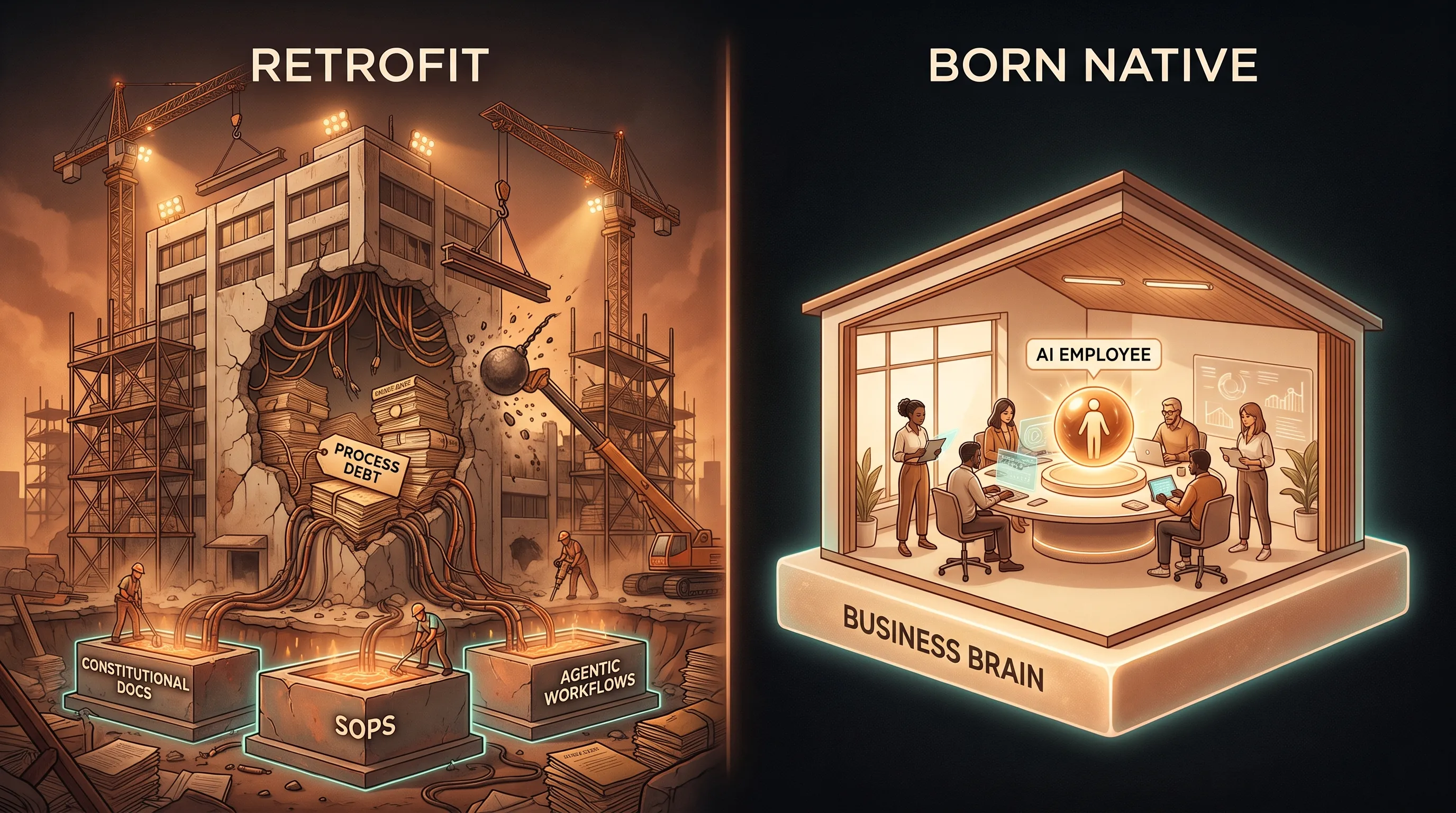
The Giants Are Renovating a House Someone Still Lives In
That’s why the AI-first stories in the news read like construction, and often like layoffs. Block didn’t add intelligence to its org chart. It cut 40% of it and rebuilt around what was left. Klarna went all the way to AI-only customer service, announced it was handling two-thirds of the chats, then quietly brought humans back when the quality and the empathy slipped. Retrofitting a company built for one era into a company built for another is expensive, and it’s painful, because every process was designed around people who are now costly to move.
A founder-led service business has almost none of that. You don’t have thirty years of process baked into forty departments. You have a founder who still knows exactly how every part of the business runs, because you’re the one running it. There’s no legacy to demolish. Which means the sentence everyone assumes about small companies is backwards. You’re not too small to be AI-native. You’re the right size to be born that way.
Born Native, at Six People
Being born AI-native doesn’t mean turning your business into thousands of agentic workflows. You shouldn’t, and you don’t have to. At your scale, native is smaller and much sharper.
It means the newest role in your company is an AI employee. One scoped job, answer every inbound lead and book the call, or log every intake the day it comes in. One person accountable for it. And the business is built around that role from the start, instead of the role getting wedged into an org chart that was finished before anyone thought about AI.
Miessler’s constitutional documents have a tiny, practical cousin at this size. You don’t need a corporate constitution. You need the context of how your business actually runs, your services, your clients, the way you talk, what a good lead looks like, captured once so the AI employee can work from it. We call that the Business Brain. It’s the same idea as his context domains, shrunk to the size of a company that can hold its whole operation in one head. If you want the full definition of what that scoped role looks like, we wrote what a managed AI employee is.
The Force Underneath All of It
Strip away the layoffs and the memos and there’s one real thing driving all of this. AI takes capabilities that used to be scarce and expensive and makes them cheap and available. The partners at Y Combinator describe founders now doing the work of 400 engineers. The revenue-per-employee numbers have gone strange with it. AI-native firms are running somewhere around $2 to $4 million per employee against a software-industry baseline near $300,000, and Midjourney reportedly hit $200 million in revenue with a core team of about eleven people.
You will never be those numbers. You don’t need to be. Those are software companies bending physics a service business doesn’t operate under. But the force that produces them is the same one that reaches all the way down to you. The thing that used to be out of reach, a full-time person doing the follow-up nobody’s getting to, just got cheap enough to have. I wrote more about who that gain actually lands on in you don’t need 300 agents.
Start Where They’re Trying to Get
The Fortune 500 is going to spend this year, and probably the next few, figuring out how to become AI-native. Consultants, reorgs, memos, the slow and painful retrofit of a company built for a different time.
You can just start there. Not by cutting anyone, because you don’t have anyone to cut. By making the first hire a company your size could never make before, and building the next few years of the business around it from the first day.
Being small was supposed to be the thing that kept you out of all this. It turns out it’s the thing that lets you in.