
“AI employee” has become one of the most stretched phrases in business software. It gets attached to a chat window you open in a browser, to a scheduling helper, to a help-desk widget, and to systems that genuinely run a workflow end to end without anyone watching. From the outside, the marketing looks identical.
If you run a service business, that ambiguity has a real cost. You’re the one deciding whether to bring one of these on, and the label tells you almost nothing about what you’re actually getting. This is a field guide for that decision — what the term should mean, how the serious versions work, and the questions that separate a real one from a good demo.
The dividing line: content versus a finished task
There’s one distinction that cuts through most of the confusion, and it has nothing to do with which model a company uses.
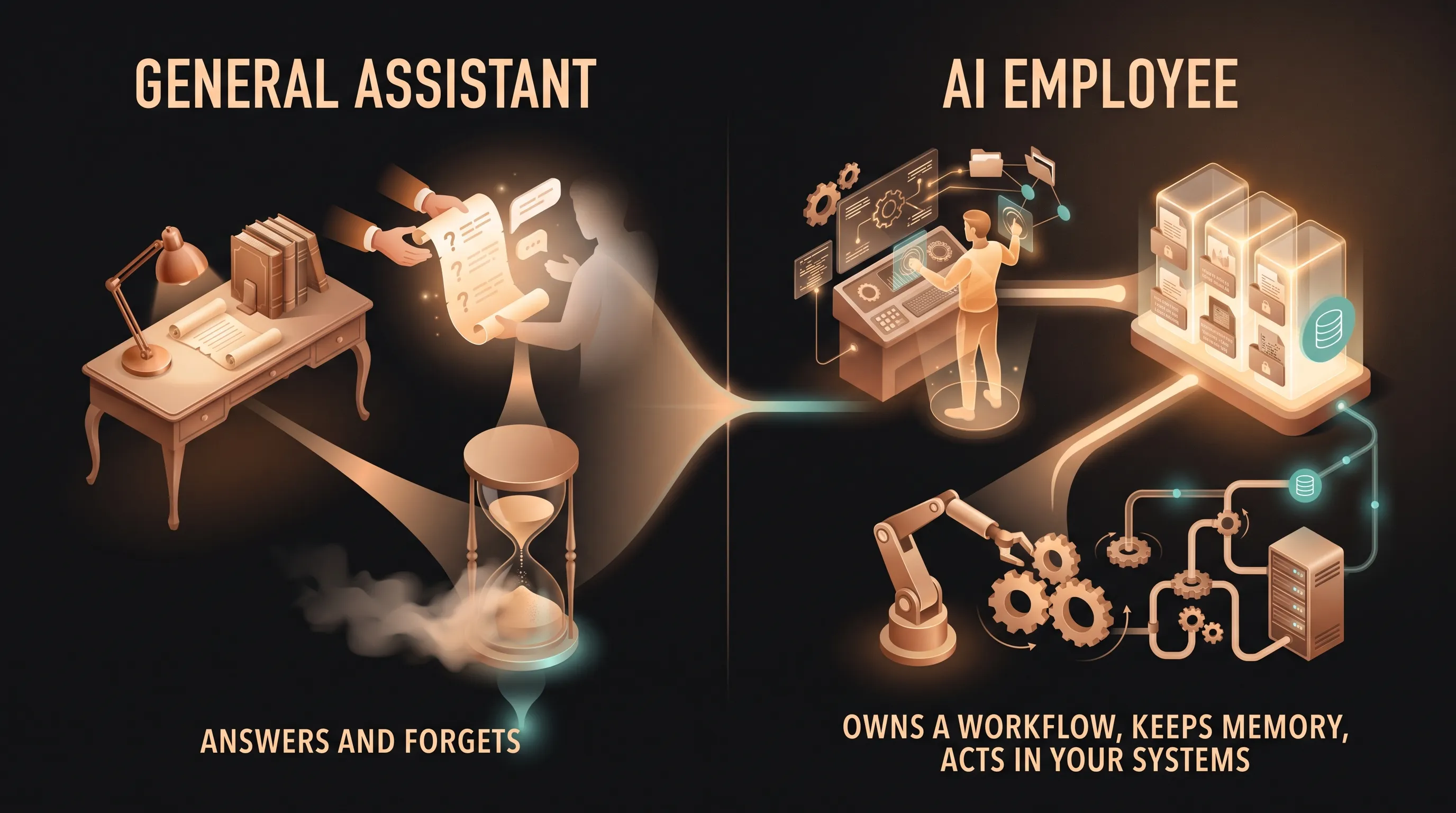
A general-purpose assistant produces content. You ask, it answers, and the session ends. It doesn’t remember the last conversation, and it doesn’t change anything in your business — you still have to take its answer and go do the work yourself.
A real AI employee finishes the task. It runs the multi-step process, keeps memory across sessions, and makes a change in one of your systems: the invoice gets entered, the intake gets logged, the follow-up gets sent. Databricks frames the test cleanly — use generative AI when the last step is a piece of content, and agentic AI when the last step is a change of state in a system.
That’s the line to hold in your head. If the last step is words on a screen that you then act on, you have an assistant. If the last step is something actually done inside your operation, you have an employee.
What’s actually under the hood
When a provider is building the second kind, a few pieces sit behind it.
Memory that persists, so the AI employee remembers your business whether the request comes in through email, chat, or a phone call, instead of starting cold every time.
The ability to operate real software. The newer systems increasingly do the work the way a person would — reading the screen, clicking, and typing — rather than depending on a fragile web of custom integrations for every app. Anthropic introduced this “computer use” capability in late 2024, and it’s becoming the standard way agents handle software that has no clean programming interface.
Observability, which is a plain way of saying someone can see what the AI employee is doing and whether it’s doing it well, so problems surface before you hear about them from a client.
But the piece that matters most to you is the least technical. A real AI employee is grounded in your business. The strongest implementations are built on your actual materials — your past work, your client language, your process — because generic knowledge can’t replicate how your firm operates. An AI that knows everything about the world and nothing about your business is not your employee. It’s a stranger with a search engine.
What good onboarding looks like
Building the thing is the easy part now. What separates a good provider is how well they understand your work before they build anything.
Expect discovery first. A serious onboarding starts with questions — a lot of them — about how your business actually runs, followed by a request to hand over your real materials so the AI employee learns from them. This matters more than it sounds: one implementation analysis found that structured discovery and onboarding produced markedly higher success rates and far fewer failed rollouts.
Then expect speed, but not magic. A good provider gives you something working quickly and tightens it week over week as you use it and flag what breaks. Be skeptical of two extremes: a provider that skips discovery entirely, and one that promises a finished, flawless AI employee on day one. The real thing is closer to hiring a person than installing an app — it gets better as it learns your business.
The cost it’s actually removing
The reason any of this is worth doing comes down to what repetitive admin work already costs you.
Take one narrow example. Handling a single invoice by hand runs about $15 to $16; when software does the same work, it drops to under a dollar. Multiply that across a few hundred invoices a month and the manual approach quietly costs tens of thousands a year that never shows up on any bill.
It isn’t just invoices. Knowledge workers spend around eleven hours a week on email alone, and repetitive admin — data entry, scheduling, chasing approvals, copying between systems — eats a large share of the week for the people you can least afford to lose to it. We ran into a small version of this ourselves when we cut our audit form from nine questions to four — every extra step quietly cost us leads.
A real AI employee earns its place by taking that specific, measurable load off your team. Not by being impressive in a demo.
What to ask before you hire one
The label won’t protect you, so bring questions instead. Five worth asking any provider:
- Do I own what you build? The workflows and knowledge base created for your business should be yours, not something you rent access to.
- Is my data used to train anyone else’s model? If your information ends up improving a system your competitors also use, that’s both a privacy problem and a competitive one. Insist that it isn’t.
- Can I leave? Ask how you’d export your data and configuration and walk away. Lock-in is the regret that shows up years later, not at signing.
- How will we know it’s working? A serious provider measures outcomes against clear criteria, not vibes.
- Have you done this in my industry? References from businesses like yours beat any feature list.
None of these are technical questions. They’re the same ones you’d ask before trusting any new hire with real responsibility.
The label is noise; the questions are the signal
The term “AI employee” is going to keep getting stretched, because it sells. That’s not a reason to dismiss the category — adoption among smaller firms is climbing fast, and the serious version genuinely takes real work off a stretched team. It’s a reason to stop reading the label and start asking the questions above.
We build these for founder-led service businesses, and we write openly about how — what works, what breaks, and what we’re still figuring out.