
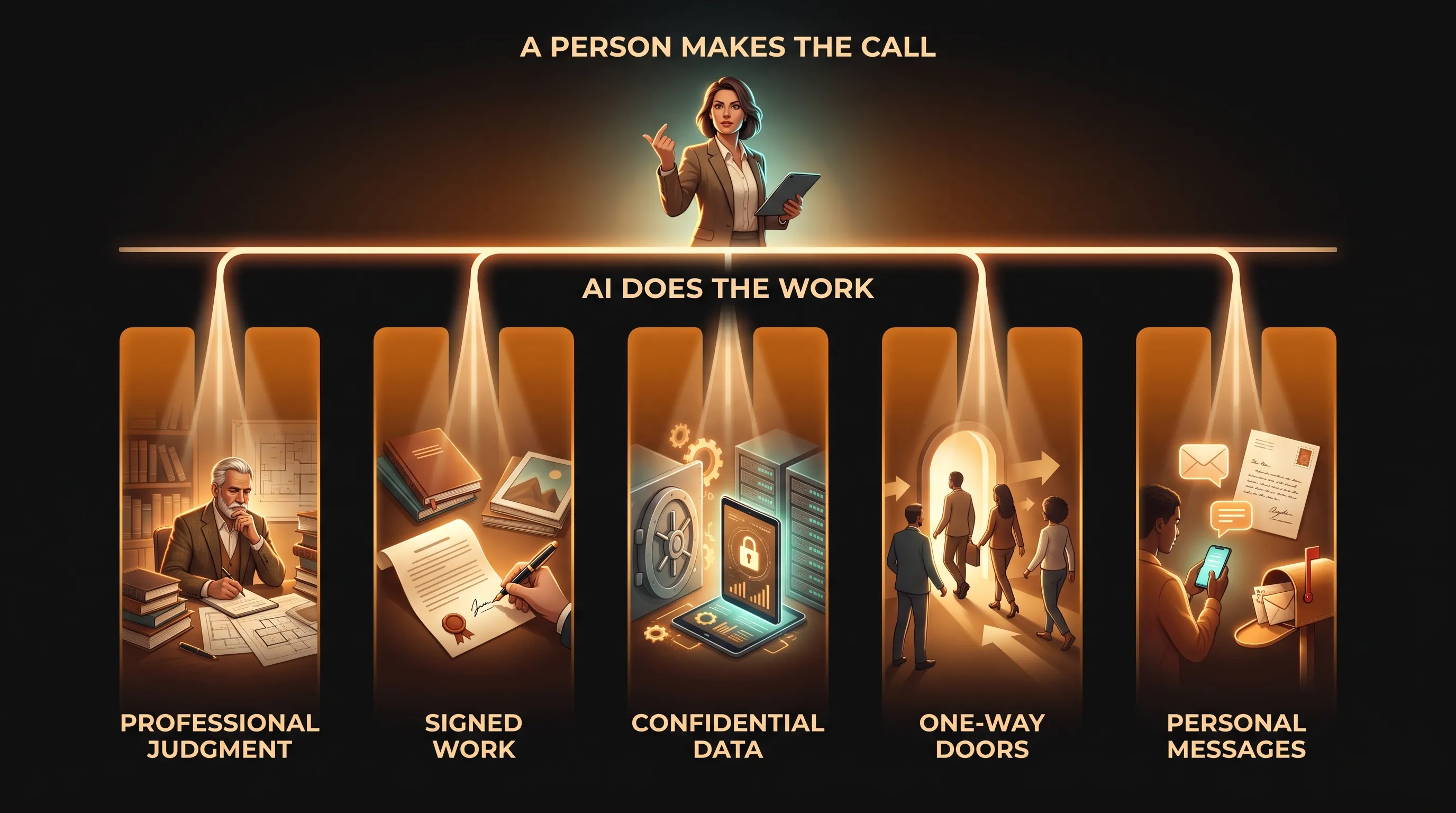
People expect a video called where not to use AI to be a list of don’ts. Mine isn’t. In my latest video I walk through five places where AI shouldn’t make the call, and what it can already do right up to that line. The pattern is the same every time. AI does the work, a person makes the call. AI is the spotter. You still lift the weight.
Judgment is a muscle
Judgment is deciding what to do when the rules run out, weighing things nobody wrote down. Medicine draws the line clearly. In California, a health plan can use AI to help review a request for care, but if that care is denied as not medically necessary, a licensed professional has to make the call, and that has been the law there since 2025.
Right up to that line, the work is fair game. AI can read a two-hundred-page medical record and pull every medication, diagnosis, and date in minutes, or lay out every settlement option and what each one could cost. There is also a quieter reason to keep the decision yourself: judgment works like a muscle, and skipping the sets makes it weaker. So don’t ask AI what to do. Ask it to argue against what you are leaning toward and name what you are not seeing. The work gets done in minutes, and the judgment stays with the person trained to make it. That is the same line I draw in the one thing AI can’t do.
Your name, your license, your client’s data
Some work is more than work. It is a promise with your signature on it. In 2024 the American Bar Association said lawyers can use AI and remain responsible for every word they file. A CPA signs the return, a doctor signs the note, and for any owner, everything that goes out under your company’s name counts the same way. The signature doesn’t stop you from using AI. It changes the job: the licensed person stops typing and starts checking. A fast way to check is to ask for the exact line behind every fact, and to drop any claim it can’t source.
Confidential data follows the same logic, and it is usually about the account, not the AI. A personal login on someone’s phone is the wrong place for client files. A company-controlled work account, set up right, where your data stays out of model training, is usually the right one. When a file truly can’t leave the building, you can often strip out everything that points to a person first, so only the work goes across.
One-way doors, and the messages that have to come from you
Jeff Bezos splits decisions into two-way doors you can walk back and one-way doors you can’t. Most are two-way, so move fast there, and a lot of that work can run on its own. The one-way doors, a ten-year lease, letting someone go, a public statement in the middle of a crisis, are where AI does all the homework and you walk through on purpose. It can read the whole lease and flag every clause that costs you, or match every invoice to its order before a payment goes out. The person who signs is still a person. You just walk in having seen every angle.
And some messages carry more than words. A hard diagnosis, a layoff after ten years. AI could write those, and they would be fine, but the other person isn’t listening for the words. They are listening for whether you showed up yourself. Use AI to prepare, to pull the whole history in seconds, even to rehearse the conversation out loud, then have it yourself. Not one of the five says don’t use AI. They all say the same thing, which is really the judgment between your rules. Pick the task you dread most, the one that is all work and no decision, and hand that one over first. If you want to see where that line falls in your business, that is what a free assessment is for.