
Your business already runs on rules, whether you’ve written them down or not. Invoice thirty days overdue, send the reminder. Job over a certain size, you approve it yourself. New booking, block the calendar. Rules are reliable, and you’ve built a lot of yours by hand.
The trouble is that rules only catch the obvious. The money hides in the judgment between them, the calls a rule can’t make.
What a rule can’t see
A rule can tell you an invoice is late. It can’t tell you whether this client is late because they’re unhappy and shopping around, or late because they always pay on the fifth. A rule can flag a new inquiry. It can’t tell you whether this one is a real opportunity and that one is a tire-kicker who’ll eat two hours.
Those are judgment calls: read something fuzzy, weigh it, decide. For years you had two options, both bad. Write an ever-more-complicated rule that still misses the nuance, or have a person read every case, which doesn’t scale. So the judgment got faked with a crude rule or skipped entirely.
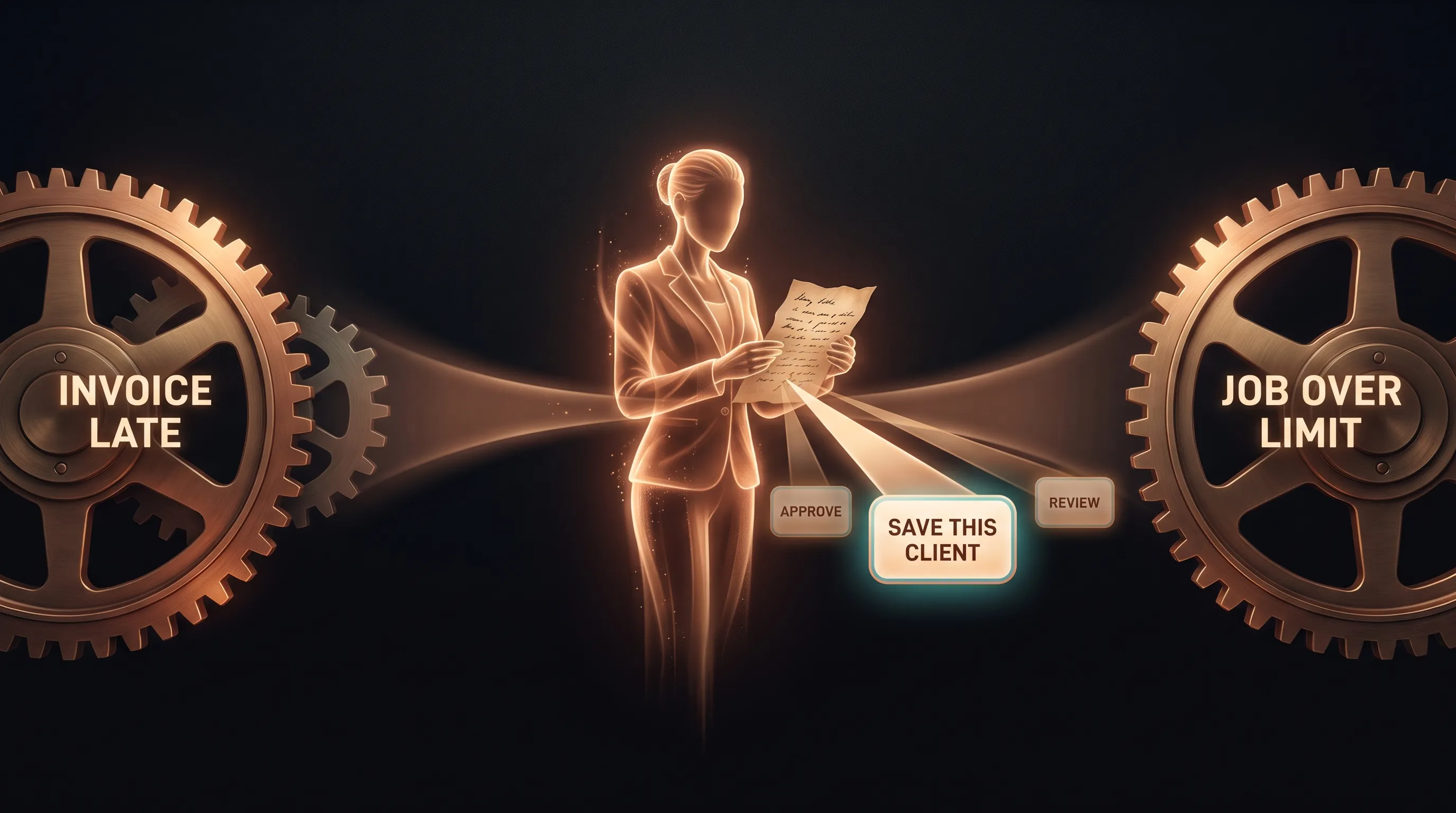
An AI employee is the missing middle. It sits between your clean rules and reads the messy thing the rule can’t, then makes the call: this late invoice smells like a customer leaving, escalate it; this inquiry is real, book it; this one, decline politely.
The gap is where the money is
It’s worth being clear about the stakes in that gap. Take one call a rule always gets wrong: a good customer quietly drifting away. Keeping them is cheap next to replacing them. Harvard Business Review notes that landing a new customer runs five to twenty-five times more expensive than keeping one you have. The rule sees a late payment. The judgment sees a customer you’re about to lose and can still save. That difference is the whole ballgame.
Multiply it across every fuzzy call your rules currently miss, and the space between the rules is where most of the upside lives.
Keep your rules, fill the gap
None of this replaces your rules. Deterministic rules are excellent at what they’re good at, and you should keep every one that works. The point is to stop asking them to do the part they can’t, the reading and weighing, and hand that to an AI employee that’s good at it, with a person on anything that carries real risk.
That’s really the job you’re hiring an AI employee to do: not to run the whole show, but to make the judgment calls that live between your rules, and to know when to pull in a human. Someone still steers the outcome, and that someone is you.
Your rules will keep catching the obvious. Put an AI employee in the gap between them, and you finally catch the rest.