
The shop across town uses the same AI you do. So does the one two exits down. Everyone can open the same window, type the same request, and get back the same competent, average answer. That’s worth sitting with, because it means the model itself can’t be the thing that sets you apart.
Daniel Miessler framed the era well: as AI gets good at average, “the thing that’s going to stand out…is the unique ideas, the novel ideas,” he wrote. For a business, the unique part isn’t a model you buy. It’s the knowledge only you have.
Same model, same answers, same voice
Point ten businesses in your trade at the same assistant and ask it to write a follow-up, quote a job, or answer a common question. You’ll get ten versions of the same thing. Competent, generic, interchangeable. It has to be, because the model only knows the average of everything it read, and it read the same internet for all ten of you.
So when a business leans on a raw model for customer-facing work, it quietly starts sounding like the average of its whole industry. That’s the opposite of an edge. It’s camouflage.
The moat is the part the model can’t know
Your advantage lives in the things that were never public. How you actually quote a tricky job. The client who gets a call, not an email. The exception your team learned the hard way. The standards you hold that the shop down the road doesn’t.
A generic assistant has none of that, and it can’t guess it. The only way it shows up in the work is if you put it there. That’s the difference between everyone’s AI and your AI: the same underlying model, reading from a Business Brain that holds your quoting rules, client profiles, and the way your company does things. Same engine, completely different output, because the knowledge feeding it is yours alone.
The signal test
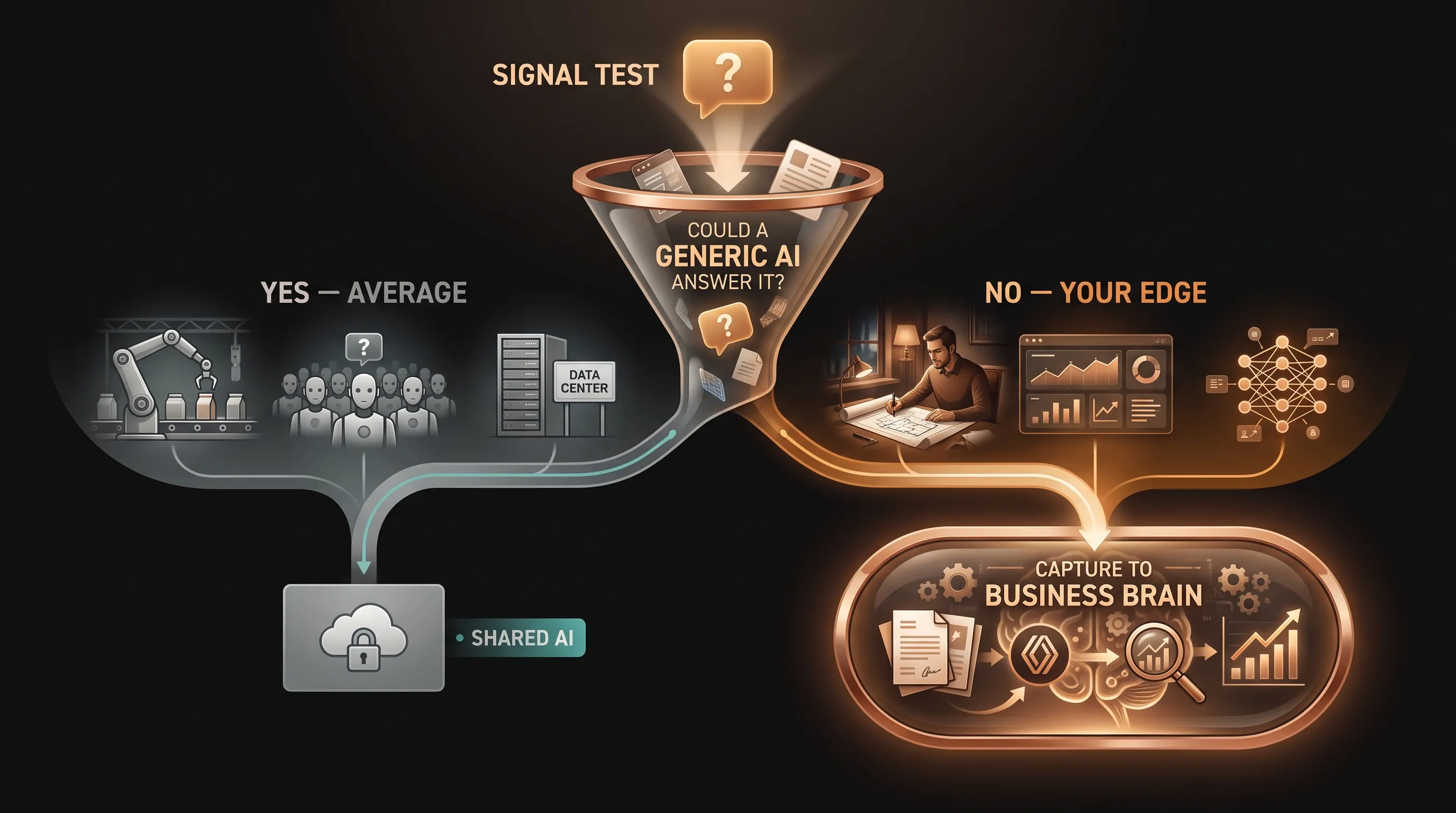
Miessler’s point gives you a clean way to sort what’s worth capturing. Before you hand a task to AI, ask one question: could a stranger with a good general assistant produce this?
- If yes, it’s average. It’s fine to let AI handle it, but it isn’t your edge and it won’t win you anything. Speed is the only prize there, and everyone gets that prize.
- If no, it’s signal. It needs something only your business knows. That’s the exact knowledge worth writing down and feeding your AI employee, because it’s the part no competitor can copy by buying the same subscription.
Run that test across a week of work and you’ll see the split fast. Most tasks are average. A stubborn few are signal, and those few are the whole reason customers choose you.
Stop shopping for engines. Start capturing knowledge.
This is why chasing the newest model is usually a distraction. The engine isn’t where competitors are separated, because everyone has the same engines. The separation is in whether you’ve captured the knowledge that makes your business yours, and wired it into an AI employee that uses it on every answer.
Your competitor can buy the same AI tomorrow. They can’t buy twenty-five years of how you do the work. That’s the asset worth building on, and it’s the reason we tell owners you don’t need the best AI, you need the right one — pointed at the knowledge only you have.