
Ask ten owners what the best AI is and most will name whatever model came out last month. Ask what they’re trying to get done, and half of them pause. That pause is the whole thing.
“Best” is a trap because it’s relative. Ask a mechanic what the best car is and the honest answer is a question: best for what? A track day and a $5 million budget point to a Pagani. A reliable commute on a tight budget points to a used Toyota. Neither is “best” until you know the job. AI works the same way, except every model is trained to sound like the best answer to everything, so if everyone asks it what to use, everyone converges on the same generic default, and pays for horsepower they’ll never touch.
The money follows the hype, and the hype doesn’t pay
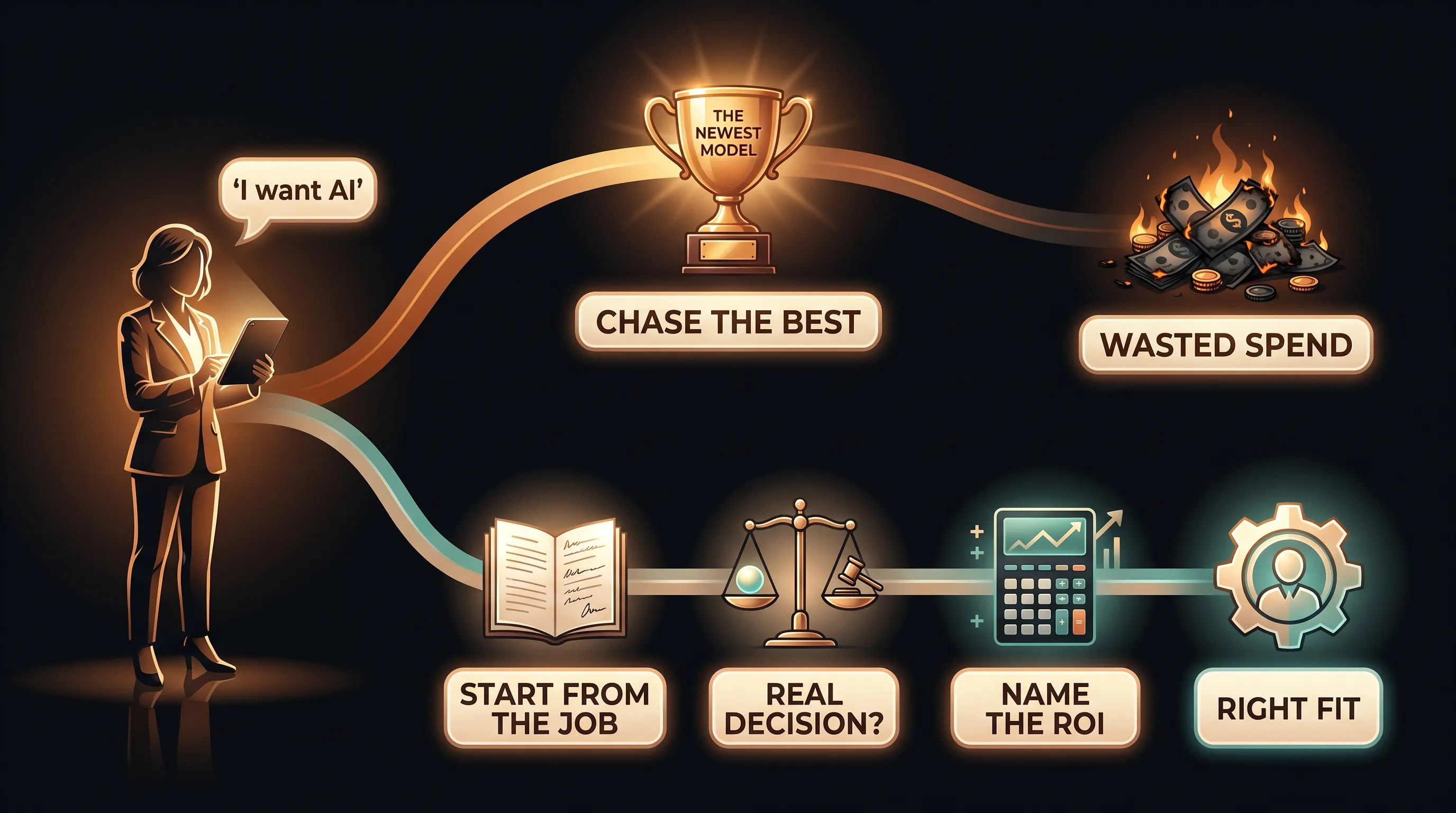
The numbers on chasing the best are brutal. MIT’s 2025 study of enterprise AI found that 95% of generative AI pilots delivered no measurable return, against tens of billions spent. And Gartner expects more than 40% of agentic AI projects to be canceled by the end of 2027, citing unclear business value and cost. Read those failures closely and it’s rarely the model that fell short. It’s that nobody started from the job.
Start with the hole, not the drill
There’s an old line in sales: nobody wants a drill, they want a hole in the wall. Push one step further and it turns out they want to hang a painting, at which point a strip of mounting tape beats any drill on the shelf. The same discovery is what’s missing from most “we want AI” conversations. Roughly half the time, the thing someone wants AI for isn’t an AI problem at all. It’s a broken process, or a form nobody filled out, or a question one good afternoon with the team would answer. If you don’t know why you need it, you probably don’t need it.
So before anyone talks about which model, there’s a plainer test worth running.
- Is there a real decision in the work? If the steps are 1, 2, 3 with no judgment call, you don’t want an AI employee. You want simple software. An AI employee earns its keep exactly where the work requires reading a situation and deciding, the way a person would. Point it at a fixed checklist and all it adds is cost and risk.
- Can you name the ROI? Not a vibe, a number. What does this save, in hours or dollars, and how would you know it worked. If you can’t answer that, the answer is don’t do it yet.
- What’s the job, in one sentence? Not “we want to use AI.” Something like “answer every after-hours call and book the ones we can.” A sentence like that quietly tells you which capabilities matter and which are marketing.
The right one is the one that fits your business
Picture ten people asked to build a calculator. Everyone reaches for the same default. But a calculator for a spacecraft and a calculator for someone who has never seen a number are completely different builds. Same output, a completely different right answer. Your business is its own version of that. The model that fits it isn’t the one topping a leaderboard this week; it’s the one matched to your actual work, wired into your actual systems, and pointed at a job you can put a number on.
That’s why we don’t open with a model name. We open with the job, then work backward to what should do it: sometimes an AI employee, sometimes a process fix, sometimes both. It’s the same reason we spend so much time on which job you should hand over first: in a market full of cheap answers, the valuable move is asking the right question before you buy anything.