
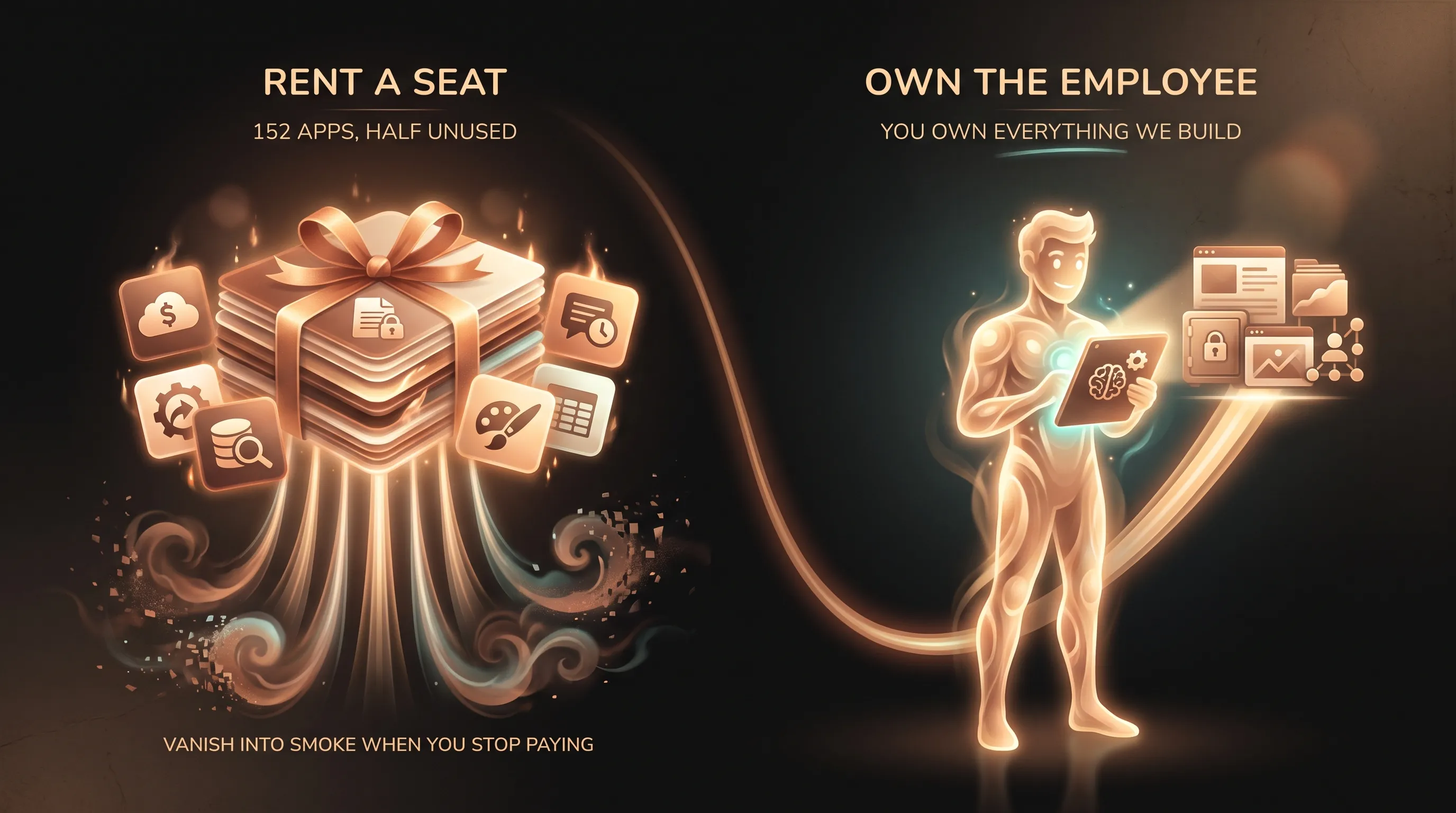
Most software sells you a seat. You pay every month for access to something someone else built, hosts, and controls; stop paying and it all disappears, along with whatever you set up inside it. That’s the deal you’ve made a dozen times over, and it’s why the average small business is quietly drowning in subscriptions. An AI employee is a different deal. You own everything we build. That single difference changes what you’re buying.
The subscription pile is bigger than you think
Add up what a business rents and the number is startling. Small companies waste roughly $89,000 a year, about a third of their software budget, partly because they underestimate how many separate products they’re paying for. Across organizations, 15% of purchased apps go completely unused and 51% are underutilized. Most companies use less than half the licenses they pay for. And the sprawl keeps growing: one 2025 index put the average company at 152 separate apps and rising. Every one of those is a seat you rent, a login you manage, and a thing you’ll lose the day you stop paying.
The trap is that renting software only ever captures a sliver of the value anyway. You’re paying for access to a capability, then still doing the work yourself. The work is the expensive part, and the subscription doesn’t touch it.
Selling work, not access
That’s the real line between software and an AI employee. Software hands you a capability and says good luck. An AI employee does the job, answers the calls, works the renewals, handles the intake, and hands you the result. You’re not buying a thing your team could theoretically use. You’re buying a job your team no longer has to do by hand.
And because we build it for your business, it isn’t a generic seat you’re borrowing. It’s trained on your operation, wired into your systems, and shaped around your edge cases. That’s an asset, not a rental, which is why the promise underneath it matters: you own everything we build. The Business Brain, the workflows, the way it handles your work: that’s yours. It doesn’t vanish because a contract lapsed.
Owning the outcome
Ownership changes how you should judge the whole thing. A subscription asks you to trust that you’ll get value out of access you’re renting. An AI employee is judged on the outcome it produces, because the outcome is the product: not the seat, not the login, not a feature checklist.
That’s also why we’d rather be measured on results than on access. It’s the difference between one more app in the pile of 152 that you half-use and forget, and a single owned asset doing a real job every day. We’ve written before about what a managed AI employee actually is, and this is the part that anchors it: it’s called an employee, not software, because you’re not renting a capability and hoping you use it. You own the work it does. That’s the whole point.