
A potential client just found your firm. They have a case, they have money, and right now they have their phone in their hand. They are going to call exactly one law firm today. If nobody picks up, they call the next name on Google.
Most firms lose that person and never even know it happened. There’s no missed-call report for the case that never became a case. So let’s walk through what actually happens, step by step, and then show what it looks like when an AI employee owns the intake instead.
The old way
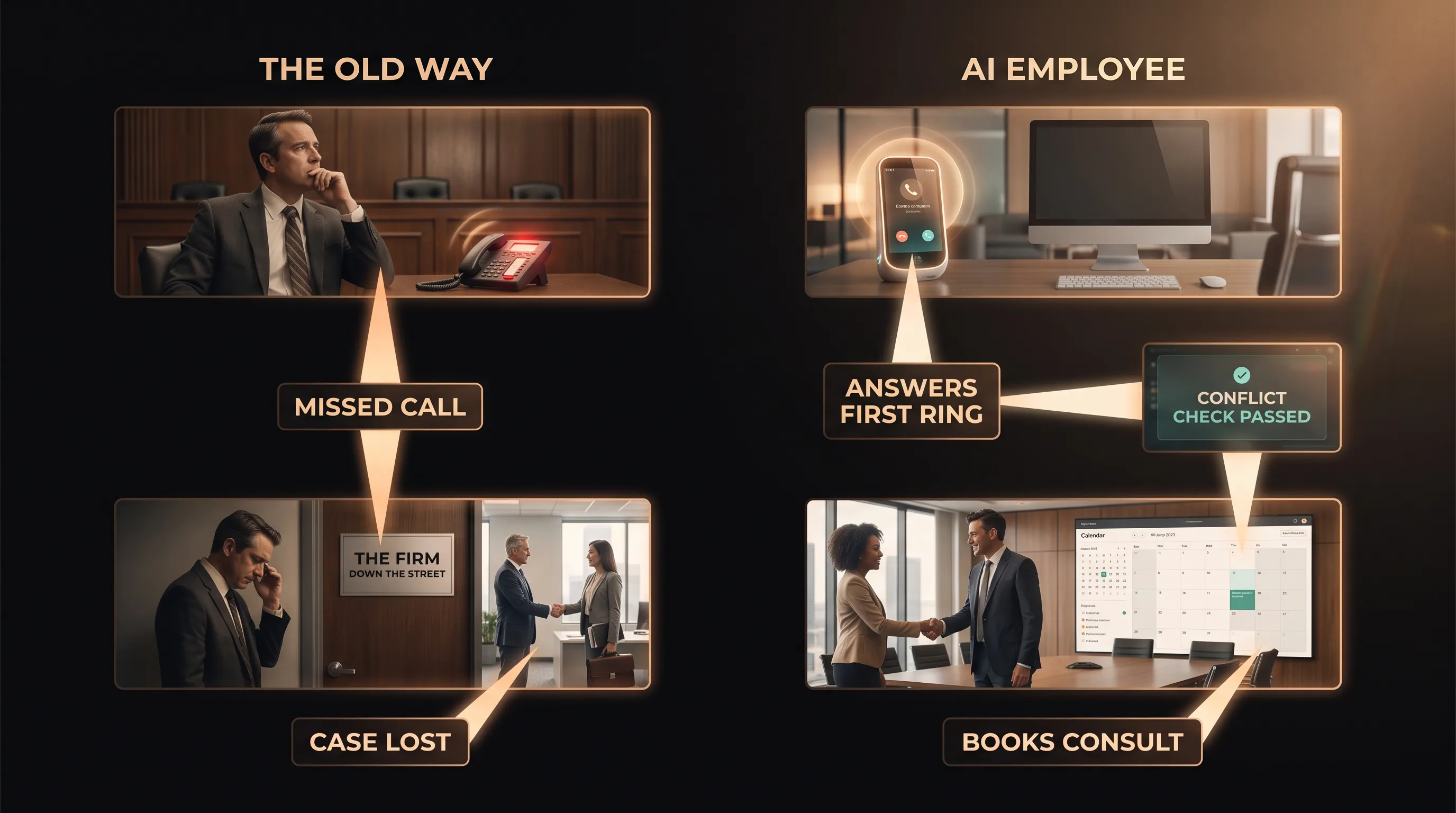
It’s 2:15 on a Tuesday. Here’s the intake, minute by minute:
- The phone rings. Your intake coordinator is on another call and the partner is in a deposition. It goes to voicemail.
- The caller doesn’t leave a message. People with a fresh legal problem don’t wait around. They call the next firm.
- Three hours later someone notices the missed call. They try the number back. No answer, because that person already booked a consult somewhere else.
- A web form comes in that same afternoon. It sits in a shared inbox until tomorrow morning.
- When someone finally reads it, they realize it’s a conflict. Two more days pass before anyone catches it.
- Nobody ran the numbers on the one real case that came in, because everyone was busy running the firm.
Every step there is a small, understandable human bottleneck. Stacked together, they add up to real money walking out the door. And the person who feels it most is the owner, who knows the leads are coming in but can’t figure out why the calendar still has holes in it.
The AI employee way
Now the same Tuesday, except your firm has an AI employee named Mia handling intake. Mia has her own email address and she’s read your Business Brain, so she knows your practice areas, your fee ranges, your intake questions, and your conflict list.
Here’s the same 2:15 call:
- The phone rings. Mia answers on the first ring, every time, day or night.
- She asks your qualifying questions in your firm’s voice, the same ones your best intake coordinator would ask.
- She runs the details against your conflict list before anyone spends a minute on the matter.
- She books the consultation straight into the calendar and logs everything in your case system.
- She drafts a first response for a human to approve before it goes out, so nothing reaches a prospect unchecked.
- The one weird case, the possible conflict, the urgent deadline, she flags for a human with the context already written up.
The caller never hits voicemail. The lead never cools off. And the partner walks out of the deposition to find the consult already on the calendar instead of a missed call they’ll never trace.
Why the tools you tried didn’t do this
Plenty of firms have already tried some AI thing. It gave generic answers and nobody used it. That’s not because AI can’t do intake. It’s because a general-purpose assistant has never seen your firm. It doesn’t know your fee structure, your conflict rules, or the difference between a case you want and one you’d refer out.
Mia works because of what sits behind her: a Business Brain built from how your firm actually runs. That’s the piece every generic tool was missing. It’s also the piece that gets smarter every week, so by month six she knows your exceptions and your best-client patterns better than a new hire would after a year.
The intake job is a good place to start for one simple reason: you can feel the loss. A dropped lead in a personal-injury or family-law firm isn’t a minor annoyance. It’s a case worth thousands walking to the firm down the street. Answer every one of those, within minutes, and the math speaks for itself.
If you want the fuller version of what separates an employee like Mia from the chat window most firms tried first, we wrote about what a managed AI employee actually is and how to tell the difference before you hire one.