
Most writing about AI employees describes the version that already works. The one running cleanly in month six, quietly saving a team fifteen hours a week. That version is real. It just isn’t the version you meet first.
We’d rather tell you what the first few weeks actually look like, because knowing what breaks is how you avoid concluding the whole thing was a mistake the first time it stumbles. Here are the four things that go wrong, and what we do about each.
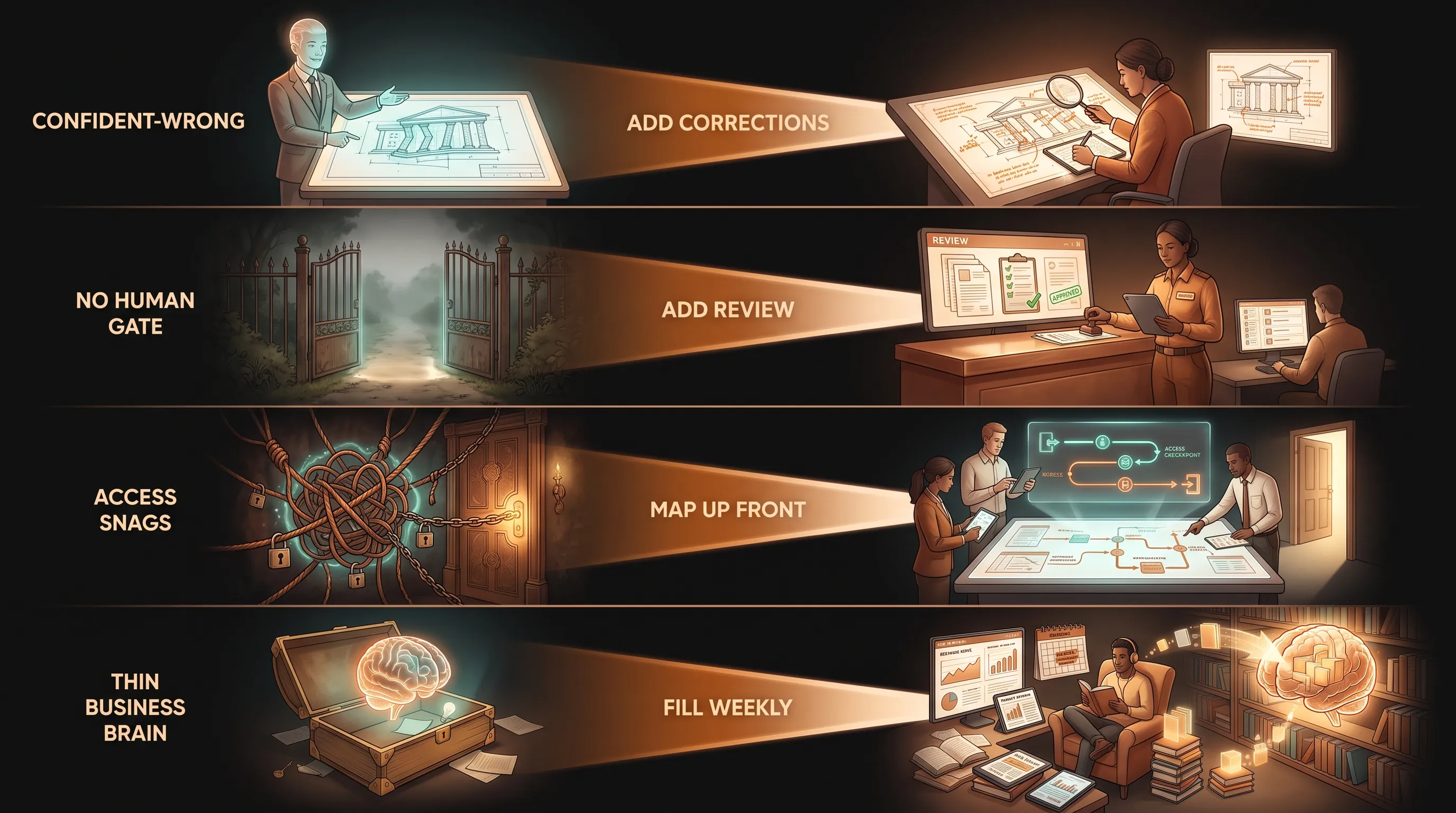
It’s confidently wrong before it learns your edges
Early on, an AI employee will do something reasonable-looking that’s flat wrong for your business. It’ll answer a question using the general rule when your firm has an exception, and it won’t hedge, because it doesn’t yet know the exception exists.
This is the failure that scares people most, and it’s the most predictable. A new hire does exactly the same thing in week one, they just do it more quietly. The fix isn’t a better model, it’s exposure. Every one of those early misses is a correction, and every correction goes into the Business Brain so the same mistake can’t happen twice. The confident-wrong phase is real, it’s short, and it’s the cost of the sharp version later.
It needs a human gate, and skipping it is how you get burned
In the first weeks, nothing an AI employee produces should reach a client without a person approving it. Not because it’s usually wrong, but because “usually” isn’t good enough when the exception lands in front of your best customer.
We build every AI employee with a human owner who reviews its output and approves anything that goes out. Owners sometimes read that as a sign it isn’t really autonomous yet, and early on, that’s fair. But the gate is the point, not a flaw. It’s what lets the AI employee earn wider autonomy the same way a person does, by getting a run of judgment calls right where someone was watching. We wrote about why that human owner is non-negotiable in what an AI employee needs before day one.
The boring blocker is access
Here’s the unglamorous truth about most stalled rollouts: it wasn’t the AI. It was permissions.
An AI employee that owns your scheduling needs into your calendar. One that runs intake needs into your case system. And getting those connections set up cleanly, with the right scope and nothing more, is often the slowest part of the whole project. It’s tedious, it involves IT or a vendor login nobody can find, and it has nothing to do with how smart the system is.
We’ve learned to front-load this. We map exactly what access a job requires before we build anything, so the work of connecting systems happens in parallel instead of surprising everyone the week we’re ready to go live.
The first Business Brain is always incomplete
The materials you hand over on day one never cover everything. There’s always a rule that lived only in someone’s head, a client type nobody documented, a “we don’t do it that way anymore” that never got written down.
So the first Business Brain is a strong start and a guaranteed underestimate. That’s not a failure of the process, it’s the process. The gaps surface exactly when the AI employee hits them in real work, which is the fastest way to find them. What matters is that finding a gap leads to filling it, week over week, instead of the whole thing quietly drifting out of date. An AI employee that gets better as it runs is the good outcome. One that’s frozen at its day-one knowledge is the thing to avoid.
Why we tell you this up front
None of these are reasons not to hire an AI employee. They’re reasons to hire one the way you’d bring on a person: with a training period, a manager who checks the work, and the patience to let it get good rather than expecting it perfect on day one.
The providers who won’t talk about what breaks aren’t hiding a smoother product. They’re setting you up to be surprised. We’d rather you know the rough parts now, handle them on purpose, and get to the month-six version faster because you weren’t blindsided in week two. That’s the same honesty we brought to cutting our own assessment form when we realized we’d built friction into our own front door.
The smooth version is worth getting to. You just get there through the rough weeks, not around them.