
People assume the hard part of an AI employee is building it. It isn’t, not anymore. The hard part is everything that has to be true before it starts, and it’s the part almost nobody talks about in the demo.
A capable AI dropped into a business with no context is not an employee. It’s a stranger with a search engine. It knows everything about the world and nothing about you, which means it can’t do your work, because your work is specific. Three things close that gap. Get them right before day one and the rest goes smoothly. Skip them and no amount of model quality will save the rollout.
One: a real job, with a defined “done”
The first thing an AI employee needs is a job small enough to actually finish.
Not “help with marketing.” Not “handle operations.” A specific, repeating workflow with a clear start and a clear end: answer the intake call, qualify it, and book the consult. Log the invoice and flag the exceptions. Chase the missing document until it arrives. When the finish line is that concrete, you can tell whether the job got done, and so can the AI employee.
Vague jobs are where rollouts die. If nobody can say precisely what “done” looks like, the AI employee can’t hit it and you can’t judge it. We spend real time up front narrowing the job to something you could hand a new hire on their first morning, because that’s exactly what this is.
Two: your materials, not just your instructions
The second thing is the part generic AI has always been missing: your actual business.
A general assistant has never seen your fee structure, your conflict list, your spec standards, or the way your best employee handles a difficult client. So it produces something bland and plausible that anyone could have written, and everyone can tell. That’s the experience most owners had the first time they tried AI, and it’s why they walked away.
The fix is to ground the AI employee in your own materials before it does anything. Your past work, your client language, your process, your rules. We call that a Business Brain, and it’s the difference between an employee who knows your firm and one who’s guessing. We went deeper on why this matters in what a managed AI employee actually is, but the short version is this: the knowledge is the product. The model is just the engine.
This is also the step that keeps getting better. The Business Brain you hand over on day one is always incomplete, and that’s fine. It fills in as the AI employee runs into your edge cases and you correct them, which is why month six is so much sharper than week one.
Three: a human who owns it
The third thing is a person. Not a person doing the work, a person accountable for it.
Every AI employee we build has a human owner who reviews its output at the start and approves anything that reaches a client. That’s not a limitation we apologize for. It’s how you’d onboard any capable new hire. You don’t hand someone the keys and disappear. You check their work, you correct the misses, and you widen their autonomy as they earn it.
The owner is also who the AI employee learns from. When it drafts a response that isn’t quite right, the owner’s correction is what teaches it your exception. Remove the human and you don’t get a faster business, you get an unsupervised one, and the first confident mistake in front of a client costs more than the whole thing saved.
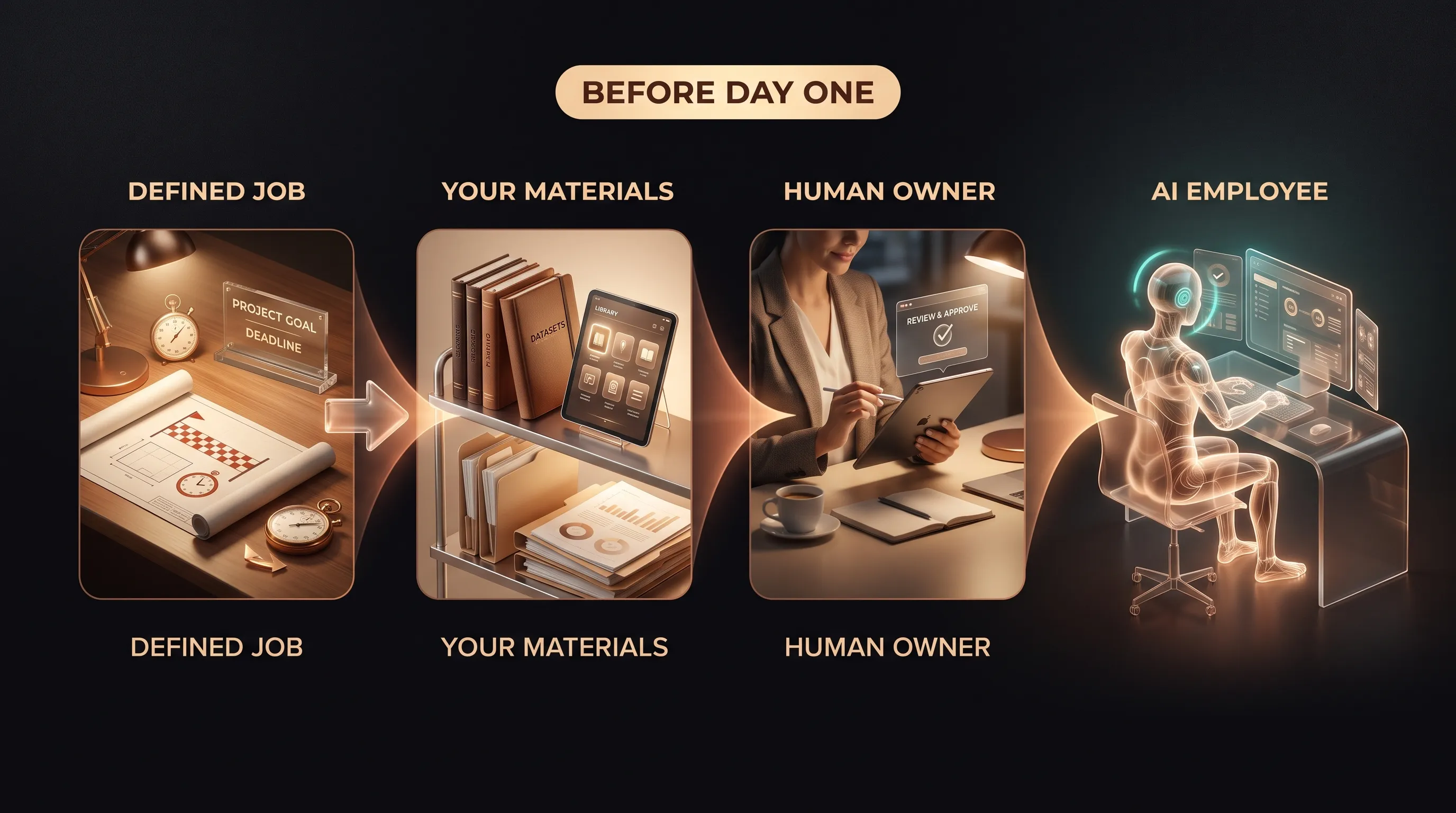
The pattern underneath all three
A real job, your materials, a human owner. Read those back and you’ll notice they’re the same three things any good hire needs. A clear role, the context to do it, and a manager who cares whether it goes well.
That’s the useful reframe. Onboarding an AI employee isn’t a software install, where the work ends at “it’s live.” It’s closer to bringing on a person who happens to learn faster and never sleeps. Do the three things up front, treat the first weeks as training rather than a switch you flip, and by the time it’s running on its own you’ll trust it, because you watched it earn that.