
Here’s a number most principals never sit with: the average RFI costs about $1,080 to process. Not the dramatic ones. The average one. A single $5M project throws off 75 to 100 of them, so you’re looking at $80,000 to $108,000 of pure administrative cost buried inside one job. Nobody bills for it. It just quietly eats the margin.
The strange part is that architecture has barely gotten faster at this in 30 years. CAD replaced the drafting table. BIM replaced some of CAD. But the actual loop of design, document, permit, build, and administer runs at about the same speed it always has. The volume went up. The productivity didn’t. So let’s walk through one RFI the way it happens now, then the way it happens when an AI employee owns the log.
The old way
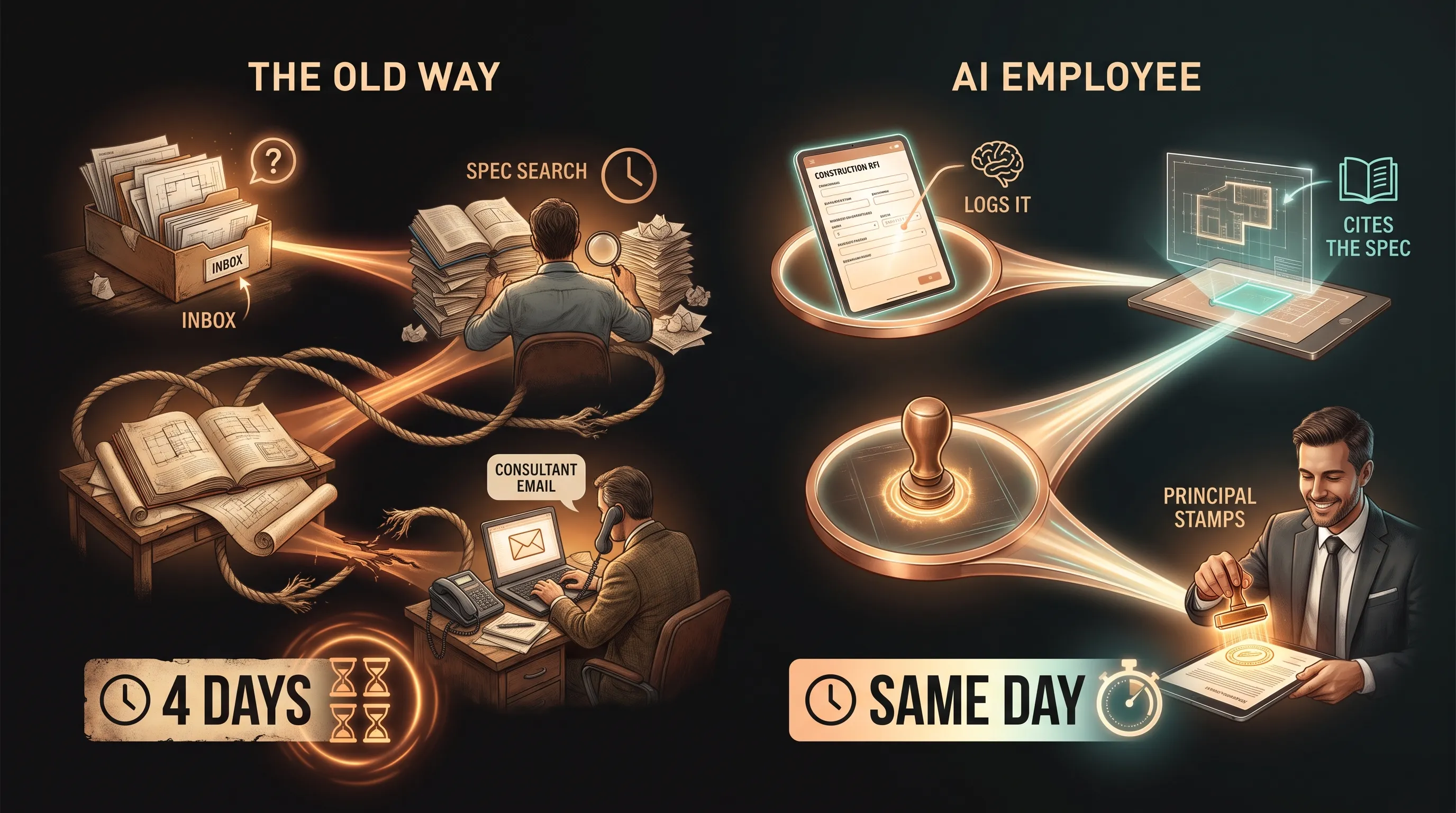
A contractor sends an RFI on Thursday afternoon. Here’s the next four days:
- It lands in a project manager’s inbox, on top of forty other things.
- Friday, the PM opens it, then goes digging through the spec to find the section that governs it.
- They pull up the drawing set to check whether the callout actually conflicts with the detail, or the contractor just didn’t read it carefully.
- They email the structural consultant a question, and wait.
- Monday, the consultant answers. The PM drafts a response, logs the RFI in the spreadsheet, and routes it to the principal.
- The principal reviews it at 9pm between two other fires, catches one thing the PM missed, and sends it back.
- Tuesday, the response goes out. Four days gone on one RFI.
Now multiply that by ninety on a single project. Every step there is a reasonable person doing careful work. Stacked together, they turn a hundred small questions into a full-time job nobody was hired to do, and the principal feels every one of them without ever being able to point at where the time went.
The AI employee way
Same RFI, except this firm has an AI employee named Aria running the submittal and RFI log. Aria has read the firm’s Business Brain, so she knows the spec, the drawing standards, the submittal rubric, and the jurisdiction rules for Miami-Dade and Broward.
Here’s the same Thursday:
- The RFI comes in. Aria logs it immediately and pulls the governing spec section and the relevant sheet from the drawing set.
- She checks the callout against the detail and identifies whether there’s a real discrepancy or a misread.
- She drafts the response, with the spec and drawing references cited, in the firm’s voice.
- The judgment calls she flags with the context already assembled: a genuine code conflict, a schedule-critical item, anything that needs a consultant.
- The reviewer checks the draft. The principal stamps. The response goes out the same day.
The stamp never leaves a human. That’s the point. Aria and the team do the work, the principal signs. What changes is that a four-day round trip becomes a same-day answer, and the hundred-RFI project stops quietly costing six figures in overhead.
You don’t have to imagine it. Aria is doing exactly this today for a South Florida firm. You can look at the work.
Why the tools you tried didn’t do this
Most firms have already tried some AI thing on a submittal. It gave a generic answer and nobody trusted it near a stamp. That’s not a limit of AI. It’s that a general-purpose assistant has never read your spec, your standards, or your jurisdictions. It doesn’t know a Miami-Dade requirement from a Broward one, and it can’t cite a section it’s never seen.
Aria works because of what sits behind her: a Business Brain built from how your firm actually documents and administers a project. That’s the piece every generic tool was missing, and it’s the piece that compounds. By month six she knows your recurring detail conflicts and your consultants’ patterns better than a new hire would after a year.
Submittal and RFI review is the right place to start for one blunt reason: you can put a dollar figure on it. $1,080 a question, a hundred questions a project. Cut the turnaround from days to hours and hand the overhead to an employee who works through the whole set without getting buried, and the math makes the decision for you.
The RFI log is only the first wedge. Once Aria has read the firm’s project history, the same employee can carry the pursuit you didn’t chase — the winnable RFQ your team passed on because nobody had 40 hours that week.