
An RFQ lands in your inbox on a Monday. It’s from an agency you’ve done good work for, the scope fits your firm exactly, and you already know you’d be a strong shortlist candidate. It’s due in ten days.
And you pass on it.
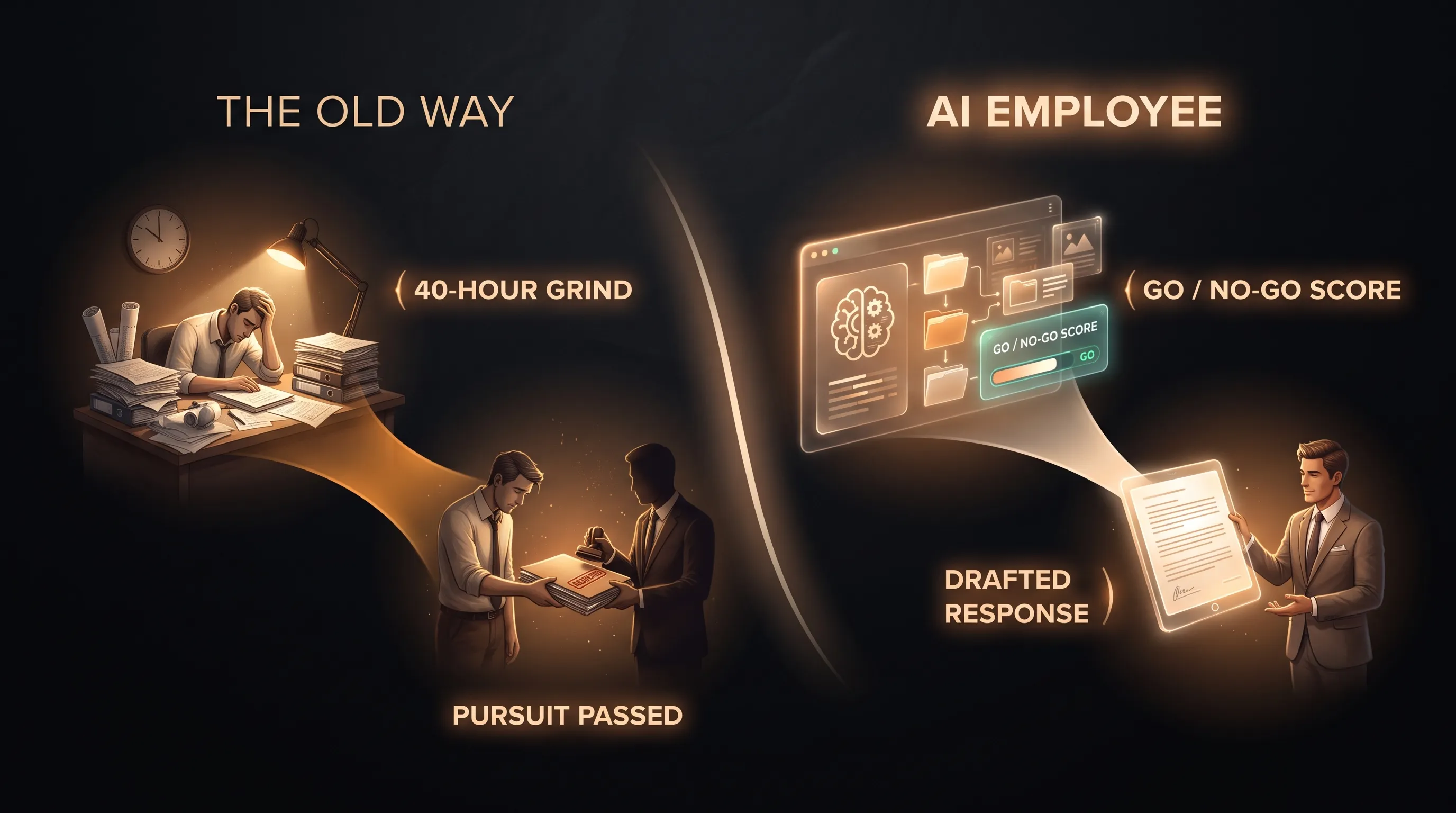
Not because you’d lose. Because nobody on the team has 40 hours this week to assemble the response, and there are three projects already on fire. So a winnable contract quietly expires, and the decision never shows up anywhere. There’s no line on the P&L for the pursuit you didn’t chase. For a firm whose most durable revenue gets won and re-won through qualifications, that’s the most expensive thing that happens all year, and it happens in silence.
Let’s walk through what a pursuit actually takes today, then what changes when an AI employee owns the assembly.
The old way
A continuing-services solicitation comes in. Here’s the next ten days, if you pursue it at all:
- Two or three days of informal go/no-go debate, squeezed between everything else. Sometimes the answer is “not this week,” and a good fit dies right there.
- If you go, someone senior starts digging through 30 years and 400 projects to find the handful that genuinely fit this scope and budget. Not a generic project dump, the right ones.
- They pull team resumes and the project list, then draft a cover letter explaining why the firm fits.
- They rebuild it all into the PowerPoint and PDF in exactly the format the owner asked for, checking the submission checklist twice so a technicality doesn’t get you thrown out.
- Roughly 40 hours of your most senior time, on deadline, spent proving a track record the firm already has.
Run that 8 to 12 times a year and you’ve spent 350 to 450 hours of principal and BD time re-proving your own history. And that’s only counting the pursuits you actually entered. The ones you skipped cost more.
The AI employee way
Same solicitation, except the firm has an AI employee named Aria running pursuit support. Aria has read the firm’s Business Brain, which now includes a structured proof library: every project’s scope, client, value, and outcome, plus the win-pattern pulled from past winning responses.
Here’s the same Monday:
- The RFQ lands in Outlook. Aria reads what the owner actually wants to see and scores a go/no-go recommendation, with her reasoning and a watch-list of flags.
- If it’s a go, she searches the proof library and pulls the relevant past projects, the ones similar in scope and within budget, not the whole 400.
- She assembles the team resumes, the project list, and a drafted cover letter, and builds the PowerPoint and PDF in the owner’s required format.
- Where the firm isn’t a credible fit, she says so instead of chasing it.
Then the humans do the part only humans should. BD reviews the draft, curates the relevant projects, and owns the positioning and the voice. The principal signs. Aria never submits anything and never makes the go/no-go call for you. What she removes is the 40-hour assembly grind in the middle, the part that was deciding which contracts you got to compete for.
The change isn’t that responses get faster. It’s that capacity stops being the reason you skip winnable work.
Aria is doing this kind of architecture work today for a South Florida firm. You can look at it.
Why the tools you tried didn’t do this
Firms have tried pointing a generic AI at a proposal before. It produced something bland that didn’t sound like the firm and didn’t know which projects to lead with. That’s not surprising. A general assistant has never seen your 400-project history, doesn’t know which past work an owner will find persuasive, and can’t tell your strong fit from your reach.
Aria works because of the proof library behind her: your qualification is your history, and until now that history lived in folders nobody could search fast. Structure it once and the right projects surface for any pursuit. It’s the same Business Brain that powers the submittal and RFI log, so once one wedge is standing, this one is nearly free to add.
That’s the quiet part worth sitting with. The 40 hours was never really the cost. The cost was every good-fit pursuit that expired because the 40 hours weren’t there, and an employee who owns the assembly is what finally puts those pursuits back on the table.