
There’s a fast way to make your business sound like every other business in your trade: hand your customer conversations to a raw model and let it talk. It won’t sound bad. It’ll sound fine. Fine, and exactly like everyone else.
Daniel Miessler had a warning inside his argument about AI and originality. The more your own way of thinking gets “quieted,” he wrote, the more you end up adopting other people’s ideas by default. The same thing happens to a company that lets generic AI speak for it. The voice that got you chosen gets quietly averaged away.
Average is the default setting
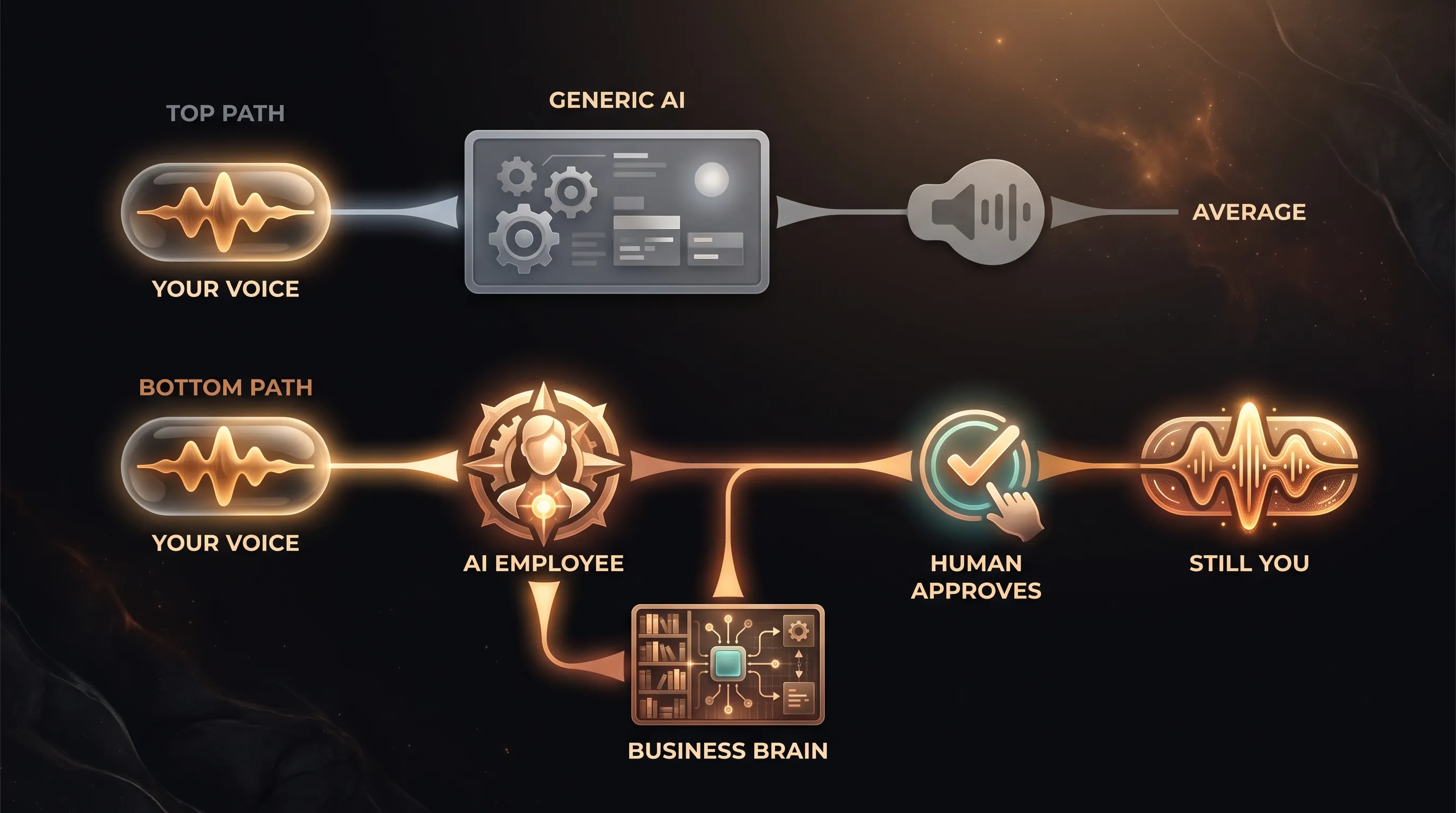
A general model is built to produce the safe middle. Ask it to answer a customer and it reaches for the most common phrasing, the most standard policy, the reply that would fit any business in your category. That’s not a flaw. It’s the point of a model trained on the average of everything.
But your customers didn’t pick the average. They picked you — your standards, your bluntness, the specific way you handle a problem. Every time a generic reply goes out under your name, a little of that gets sanded off. Do it long enough and your business reads like a template, because that’s what’s writing it.
Your voice is a set of decisions, not a vibe
“Sounding like you” feels fuzzy, but it’s made of concrete decisions. What you promise and what you refuse to promise. How you deliver bad news. The policy you hold that competitors bend. The three things you always mention and the one thing you never do.
Those aren’t style. They’re your business’s judgment, written down. A generic model can’t infer them, so if they aren’t captured somewhere, they don’t make it into the work. What’s left is the average, wearing your logo.
Keep the voice by feeding it, then checking it
Keeping your voice while using AI isn’t about a clever prompt. It’s about what the AI reads before it speaks, and who signs off after.
- Give it your knowledge to read. An AI employee answers from a Business Brain — your policies, your standard replies, your way of phrasing things — so the draft starts from your decisions instead of the industry average.
- Keep a person on the last step. The AI employee drafts; someone on your team approves before it goes out. That approval is where your voice is protected and where a wrong note gets caught. Nobody is rubber-stamping a black box.
That second step matters more than it looks. It’s the difference between AI that speaks as your business and AI that speaks as the average of your industry and hopes you don’t notice.
The differentiator you already own
The good news is you don’t have to invent an edge. You already have one — the specific, slightly stubborn way your business does things. The risk isn’t that AI can’t match it. The risk is that, used carelessly, AI erases it and hands you the average in return.
Used deliberately, it does the opposite: it takes the routine off your plate while keeping every word sounding like you. That only works when the thing writing on your behalf is actually yours, which is the whole reason we build it so you own the employee, voice and all.