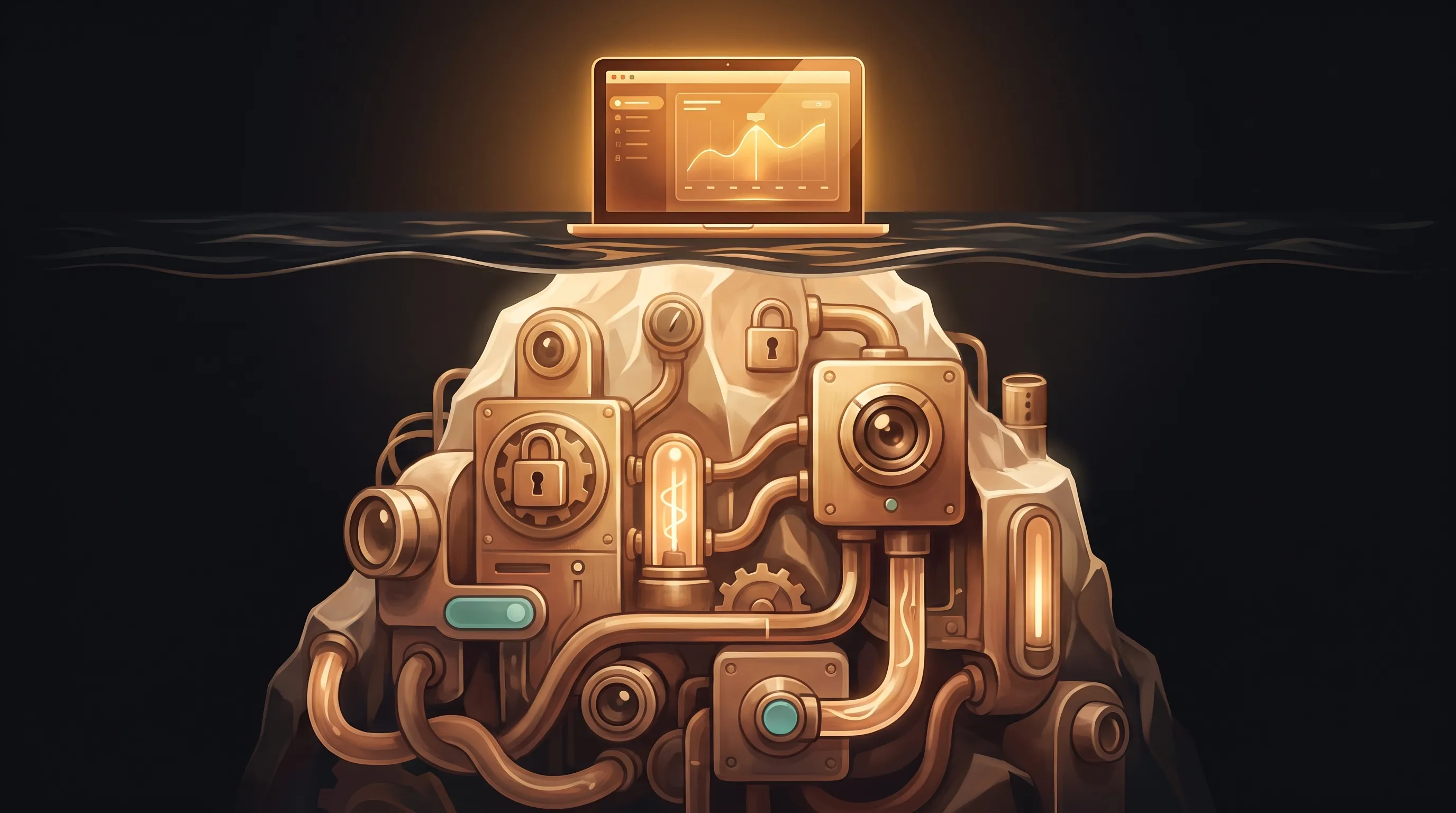
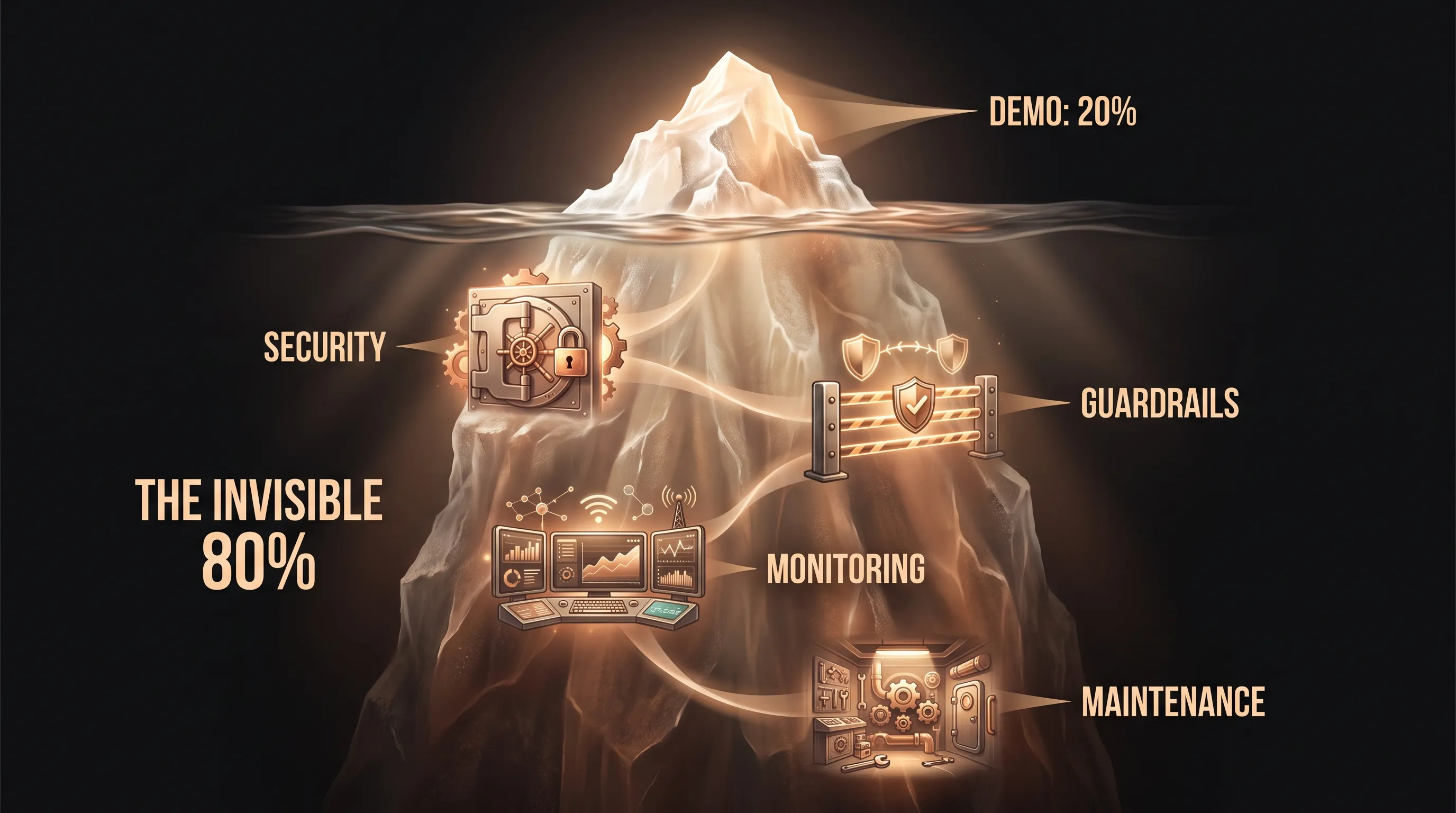
The demo is where everyone feels the excitement. You watch an AI answer a call or draft a reply and something clicks. It’s also where most of the excitement gets spent, because the demo is maybe 20% of the work. The other 80% is invisible, boring, and the entire reason the thing keeps working next month instead of falling over in week three. That 80% is what you’re paying a managed service for. It’s also what almost nobody shows you.
We’d rather show you. It’s the honest picture of what an AI employee is.
Where the invisible 80% goes
A working demo makes one good decision once, in a controlled setting. A working AI employee makes thousands of decisions, on real customers, unattended, without doing anything you’d regret. Everything between the two is the hidden mass under the waterline:
- Security and access. In a demo, nobody asks what the AI can reach or who can reach it. In production, that’s the first question. What data can it see, what can it do, what is it never allowed to touch, and why did it choose the action it chose.
- Guardrails and validation. The real world is messier than the demo. It needs checks around the model that catch the weird input, the angry caller, the request that should stop and wait for a human instead of pressing ahead.
- Monitoring and logs. You can’t manage what you can’t see. Every decision gets recorded, reviewed, and watched, so a drift in behavior shows up as an alert, not as a customer complaint three weeks later.
- Maintenance. The business changes (new services, new rules, new rates), and the AI employee has to change with it. A thing that worked at launch and was never touched again is a thing quietly going wrong.
None of that fits in a demo, because none of it is exciting. It’s the difference between a party trick and an employee you can trust with your phone line.
The graveyard is full of great demos
This is exactly where the industry’s failures cluster. It isn’t that the models can’t do the task. It’s that the task was the easy part. MIT found 95% of enterprise AI pilots delivered no measurable return. Gartner expects more than 40% of agentic AI projects to be canceled by the end of 2027. And a 2025 S&P Global survey found 42% of companies abandoned most of their AI initiatives, scrapping nearly half their proofs of concept before production. Those aren’t model failures. They’re what happens when someone falls in love with the 20% and never budgets for the 80%.
Why “managed” is the whole point
Not every job even needs an AI employee. Plenty of small, predictable tasks are better handled by plain software, and part of our job is telling you when that’s the case. But when the work does call for one, the invisible 80% is the difference between renting a demo and hiring something that holds up. Managed means someone owns the security, the guardrails, the monitoring, and the upkeep, so that when the business shifts or a strange call comes in at 2am, it’s already handled and you never had to think about it.
We’ve been open about the fact that things do break when you bring on an AI employee. This is the flip side of that honesty: the reason to work with someone who lives in the 80% is that it’s precisely the part you can’t see until it’s the part that failed. The demo is easy. Keeping it working is the job.