
The malpractice claim that ends a small firm usually isn’t a dramatic loss in front of a jury. It’s a deadline nobody calendared. A conflict nobody flagged. A citation nobody checked. Quiet, administrative, and almost entirely preventable.
For years, administrative errors have made up roughly a quarter to a third of legal malpractice claims. The fix was never working harder. It’s leaving a trail.
Answers you can’t audit are a liability
An AI employee that hands you a finished answer with no trail is the same risk as a brilliant associate who never shows their reasoning. When you can’t see how it got there, you can’t catch the step it missed. And the missed step is where the claim comes from: the ABA’s own profile of malpractice claims put administrative errors like blown calendaring at around a quarter of all claims, a share that only fell as firms adopted better calendaring and record-keeping.
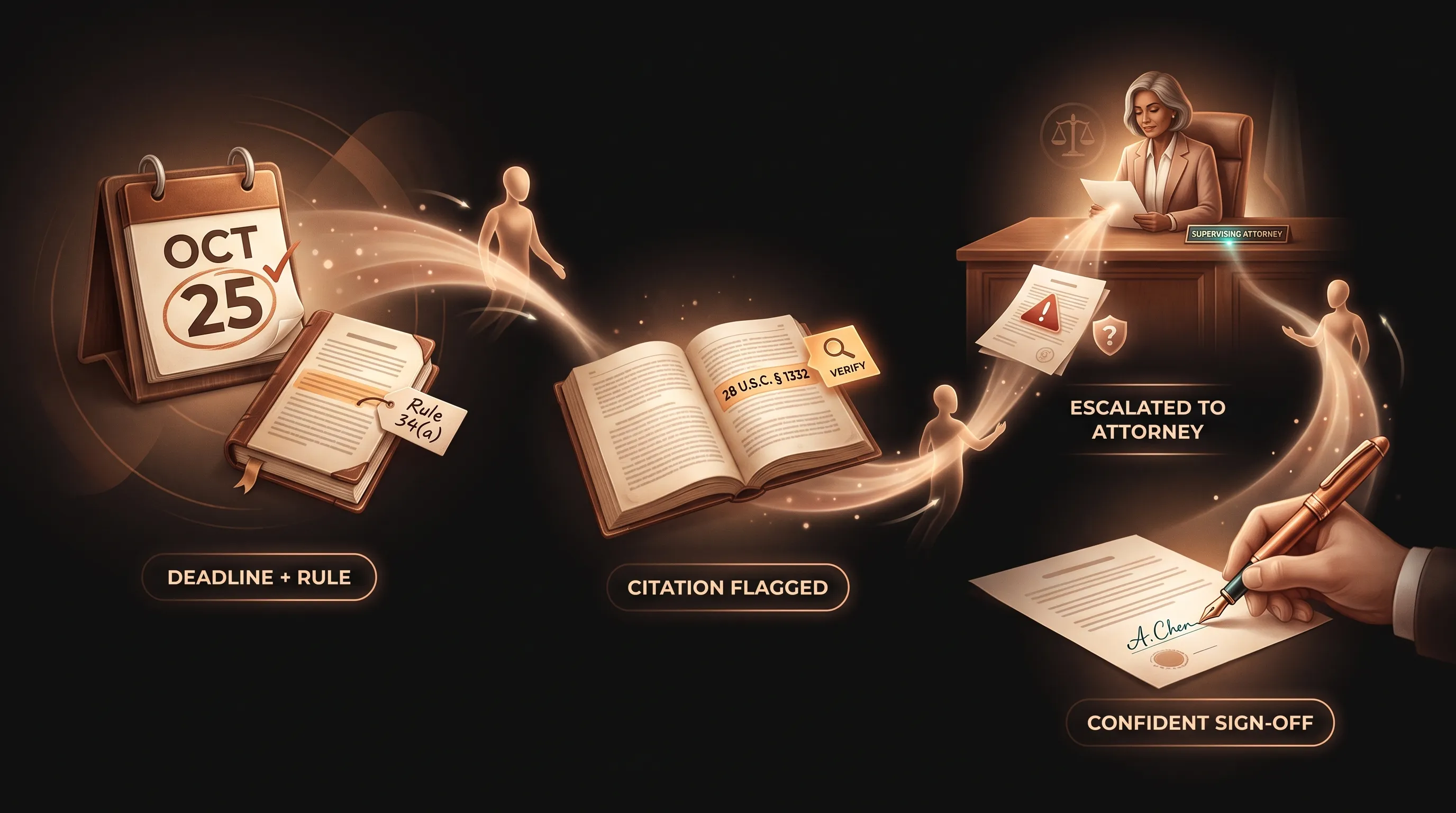
So Clerko is built to show its work. Every citation comes back flagged for you to verify, with the passage it relies on. Every deadline it spots gets written down next to the rule that sets it. Every assumption it made is surfaced instead of buried three paragraphs deep. You are not trusting a black box. You are reviewing a marked-up draft.
Escalation is a feature, not a failure
The most valuable sentence an AI employee can produce is “a human should look at this.” Clerko drafts and organizes, and then it stops at the lines that carry risk: a live deadline, a possible conflict, anything that touches an ethics rule. It escalates to the supervising attorney with the context already written up, rather than deciding on its own and hoping.
That restraint is the point. A capable employee that knows the edge of its competence is worth more than a confident one that doesn’t. The escalation isn’t the system failing. It’s the system working exactly as a well-run firm would want a junior to work.
The record that protects you
The trail isn’t bureaucracy. It’s the thing that lets you sign off with confidence and prove, later, that the work was done the right way. A defensible file is one where every decision has a visible reason behind it, and where the deadline that matters was caught, dated, and owned.
It’s the same discipline behind why one wrong click can mean nine seconds to delete, thirty hours to recover, and why someone has to steer the work rather than let it run loose. Nothing files without your name on it. The difference is that now you can see everything you’re putting your name to.
Show your work isn’t a grade-school rule. In a law firm, it’s the line between a defensible file and a claim you never saw coming.