
There’s a story behind our favorite question to ask a new client. A real-estate company called Teles Properties grew from $300 million to $3.4 billion, and when they dug into why customers stayed, the answer kept collapsing to one sentence: “being here saves me a day a week.” That line became the whole pitch, and then a filter for what they built and what they cut.
We borrowed it. Before we build anything for you, it has to pass one test: does this give you back a day a week? If the honest answer is no, we won’t start there, no matter how impressive it would look in a demo.
The day you’re already losing
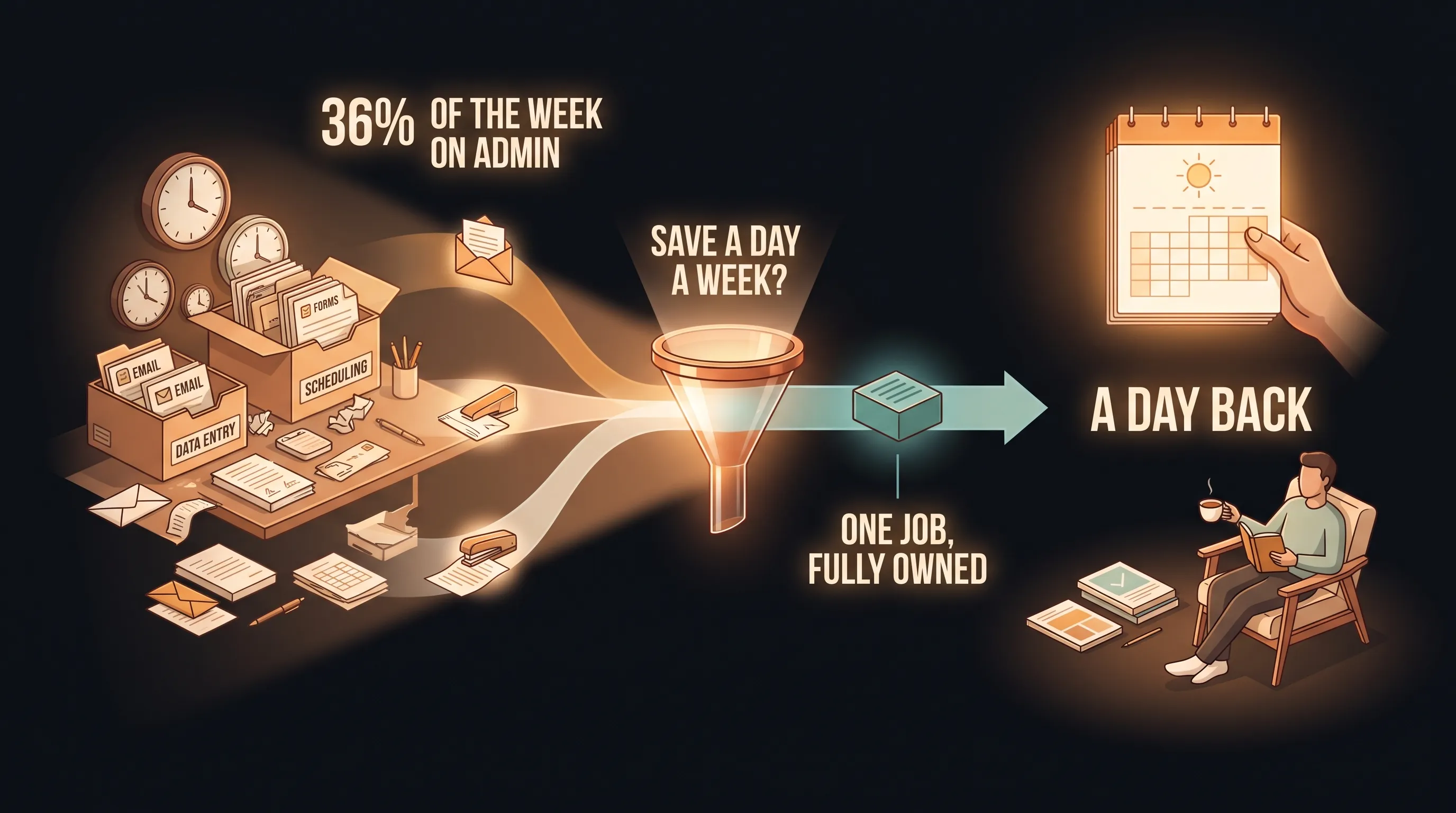
The reason the filter works is that most owners are already bleeding a day a week and don’t quite see it, because it leaks out in fifteen-minute pieces. The research is blunt about the size of it. Entrepreneurs spend more than a third of the work week on small administrative tasks: invoicing, scheduling, data entry, chasing replies. A separate behavioral study clocked about 2.5 hours a week on email alone and another 1.5 on manual data entry. None of it is the work you started the business to do. All of it is the work that keeps you from doing it.
That’s the day a week hiding in plain sight. And it’s why the first job you hand off matters more than which model does it.
Why “save a day a week” is the right filter
Plenty of tasks can be handed to an AI employee. Far fewer are worth handing over first. The filter sorts them, because a day a week is a threshold that forces honesty:
- It demands a real number, not a vibe. “This would be nice” doesn’t survive the question. “This eats six hours every week” does. If you can’t put hours on it, it’s not the place to start.
- It points at the repetitive, not the exciting. The jobs that give back a day are the dull, high-frequency ones: the calls, the follow-ups, the intake. Not the clever one-off everyone wants to show off.
- It protects you from over-building. The temptation is always to add more: more features, more scope, more “while we’re at it.” A day a week is subtraction. It asks what single thing, taken off your plate, changes your week, and ignores the rest.
There’s a principle under that last one worth saying plainly: to do great things, you have to do fewer things. Cutting hard usually recovers most of your time at a small cost to everything else. The first AI employee should do the same: win back a real chunk of your week by owning one job completely, not shave a few minutes off ten.
Start where the hours are
So when we say we won’t build it if it doesn’t save you a day a week, that’s the discipline that makes the first hire land. Point an AI employee at the job that’s quietly costing you the most hours, prove it there, and you get something better than a clever demo. You get a day back, every week, to spend on the work only you can do.
It’s the same reason we’re so particular about which job you hand over first. Pick the one that gives you back a day, and everything after it gets easier. Pick the shiny one that saves twenty minutes, and you’ve bought a demo. The filter tells you which is which before you spend a dollar.