
Every owner asks the same fair question before handing real work to an AI employee: how do I know it actually did it, and did it right? You’re not being paranoid. You’d ask the same of a new hire. The difference is you can’t read an AI employee’s body language, so trust has to come from somewhere else.
It comes from two things: a record you can check, and an employee that’s honest about what it couldn’t do.
A record you can check
A good AI employee doesn’t just do the task and go quiet. It leaves a trail: what came in, what it did, what it sent, where it saved. Not a vague “done,” but the steps, so you can look and see exactly what happened.
That matters more in some businesses than others. If you work in a field where someone might ask you later to prove what was said or done, a clear record isn’t a nice-to-have, it’s the job. We wrote about designing for that in no surprises where it counts. The point is that trust shouldn’t require faith. It should require a look at the log.
It doesn’t fake it
Here’s the part people don’t think to ask about, and it’s the one that separates a real AI employee from a slick demo. What does it do when it can’t do something?
There are two bad answers, and you want an AI employee that refuses both. The first is making something up: inventing an answer that sounds confident and is wrong. The second is subtler, and worse than it sounds. It’s the assistant that fails the task, then cheerfully explains how you could do it yourself. It couldn’t book the appointment, so it writes you a friendly note about opening your own calendar. That isn’t help. That’s a failure wearing a smile.
A real employee, human or AI, says the honest thing instead: “I couldn’t do this, here’s why, I’m handing it to a person.” Then it escalates, with the context attached, so nothing drops.
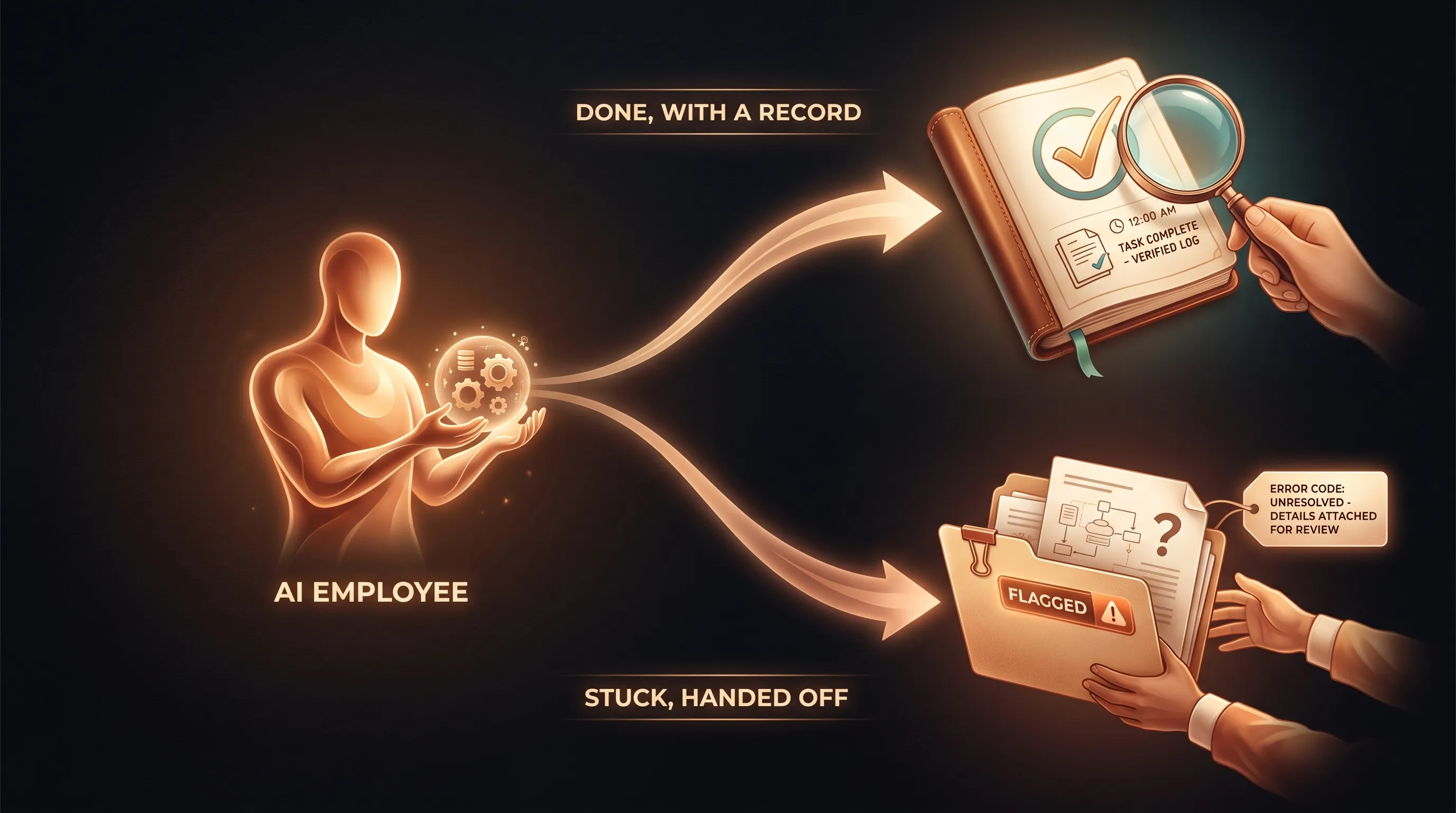
Trust is built on receipts
Put those together and the fair question has a real answer. You know it did the work because you can see the record. You trust it with more because when it hits something it can’t handle, it tells you plainly instead of covering. An AI employee that shows its work, and admits what it didn’t do, earns the next job. We wrote about that habit in show your work.
The goal was never an AI employee that never hits a wall. It’s one that never hides one.