
Ask AI to write a proposal and you get something polished, safe, and completely forgettable. Swap the logo and any company in your industry could have sent it. In my latest video I dig into why that happens, and the fix surprises people. It isn’t more instructions, it’s examples.
The zip file and the desk
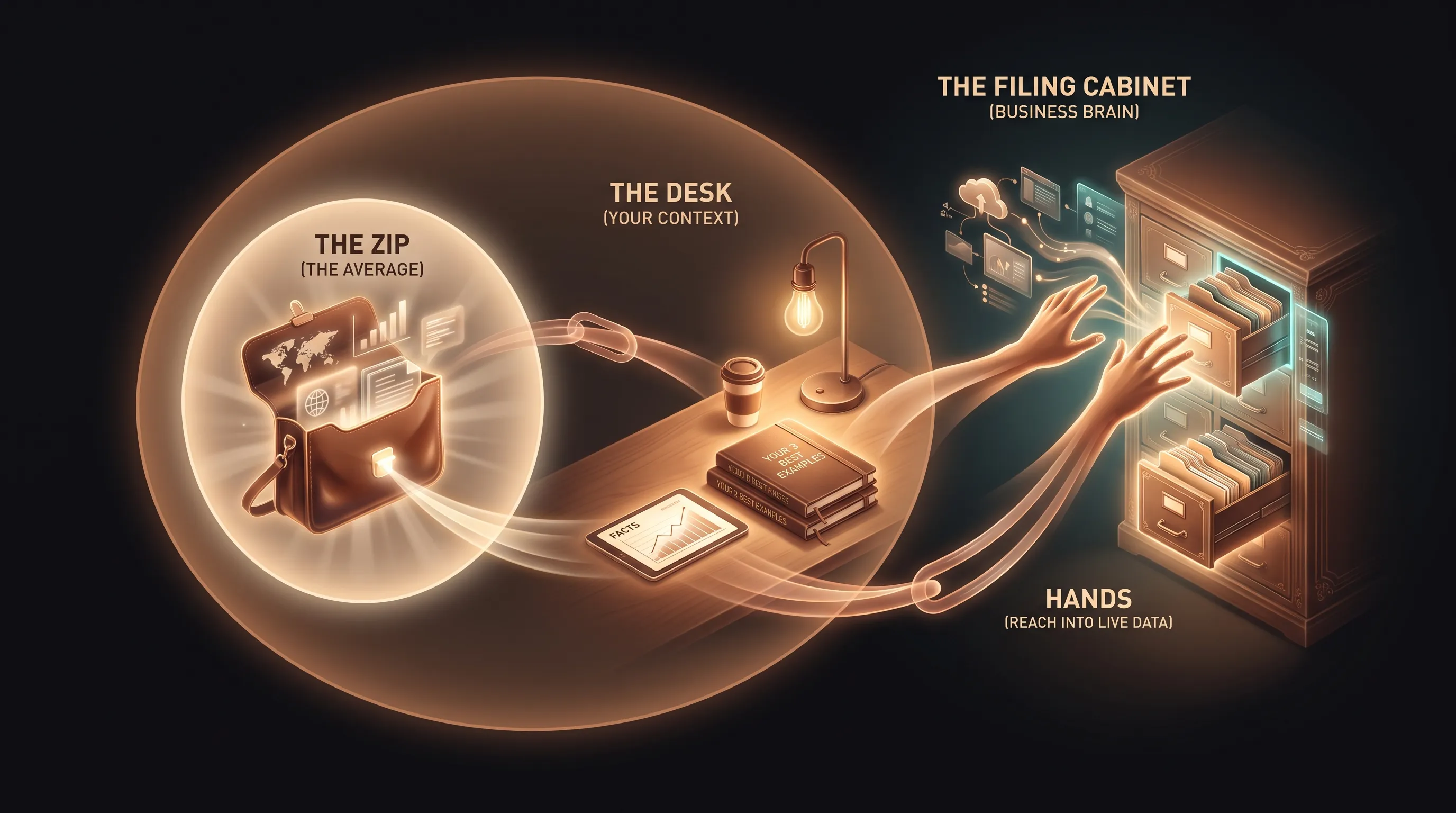
Andrej Karpathy, who used to run AI at Tesla, describes a model as a lossy zip of the internet. Picture a huge slice of the web, articles and manuals and a whole lot of proposals, squeezed into one file that keeps the patterns and throws away the pages.
So when you ask for a proposal, it doesn’t look up yours. It produces the most likely one, which is roughly the average of every proposal it has ever seen. Polite, safe, generic. Nothing went wrong there. That is the zip doing exactly its job.
Your business was never in that zip. The only place it can live is what Karpathy calls context, the model’s working memory. Think of it as a desk: your question, the files you add, what you said a minute ago. A fresh chat starts with an almost empty desk, which is the same reason a generic chat window forgets your business the moment you close it.
Why examples beat instructions
In the video I follow one company the whole way. Elena runs a forty-person commercial cleaning operation, and her first draft reads like anyone’s. So she adds the facts a model can’t guess: a dental group with three offices, five nights a week, one fixed monthly figure, the same crew at every site. Better. But read it out loud and it still doesn’t sound like Elena.
Then she does the one thing that changes everything. She pastes in three proposals her clients already said yes to, each labeled as an example. Now the draft opens the way she opens, uses her section order, ends on the line she always ends with. Instructions describe what you want. Examples hand the model something better than the average to copy.
This is not a trick, it’s how these models learn fastest. Anthropic, the maker of the Claude models, calls well-chosen examples one of the most reliable ways to steer the tone, format, and structure of an answer. Three real proposals leave very little left to guess.
From the desk to the filing cabinet
Three rules make examples work. Use your best work, not your typical work, because it copies the habits you would rather it dropped. Pick three that differ, a big job, a small one, a tricky client, so it learns the pattern instead of parroting one. And say why each one worked, in a line: this won because the cost was on page one.
Nobody wants to paste all of that in every time, so you give the AI employee a filing cabinet next to the desk. Your services, your best replies, your proven proposals, organized once and kept current, with the right pages pulled up whenever it works. That cabinet is what we mean by a business brain, and setting one up is most of training it on your business.
Here is a five-minute test you can run today. Pick one thing you write every week. Ask for it cold, then ask again with the facts, then a third time with three of your best examples, each in a new chat. Put the three side by side, and the gap between them is the whole point of the video. If you want help deciding what belongs in your business brain first, that is exactly what a free assessment is for.