
You’ve watched it happen. You ask the AI for something that felt simple: draft the follow-up, sort the overnight inbox, answer the question the customer asked. What comes back is fast, confident, and not quite what you meant. Not wrong, exactly. Off, in a way you can feel but can’t always name.
Every one of those misses is the same miss wearing a different face. The machine didn’t know exactly what you wanted. That’s the whole problem. Almost everything sold to fix your AI is circling that one gap.
The gap is between your head and the model
The thing that makes your business yours lives mostly in your head. The standard you’d never write on a website. The client who gets a phone call, not an email. The discount you’ll extend once but never twice. The refund you approve on sight and the one you always question first. The model can’t see any of it. It sees the words you typed, and it fills the rest with a confident guess.
So the failure isn’t the model failing. It’s the model doing exactly what you asked, with no idea what you meant. A recent MIT study put a number on how often that ends in nothing: 95% of enterprise generative-AI pilots deliver no measurable impact on the bottom line. The researchers were blunt about the cause. The problem was not the quality of the AI models. It was the gap between a generic system and the way a specific business runs. The models are good. What they’re missing is you.
Prompting was never the scarce skill
For two years the industry insisted the skill to learn was “prompt engineering,” the right magic words in the right order. It was a detour. Better words don’t close the gap. They only describe it more fluently.
The scarce skill is quieter and harder: articulating intent. Saying precisely what “good” looks like. Naming the exception before it happens instead of after. Deciding, out loud, when the AI should act on its own and when it should stop and ask. A vague request to a brilliant model gets you a brilliant answer to the wrong question, delivered too fast to catch before it reaches a customer.
This is most of what people mean when they say a job takes judgment. Judgment isn’t mystical. It’s knowing your own standard well enough to hand it to someone (or something) and have it come back the way you would have done it yourself.
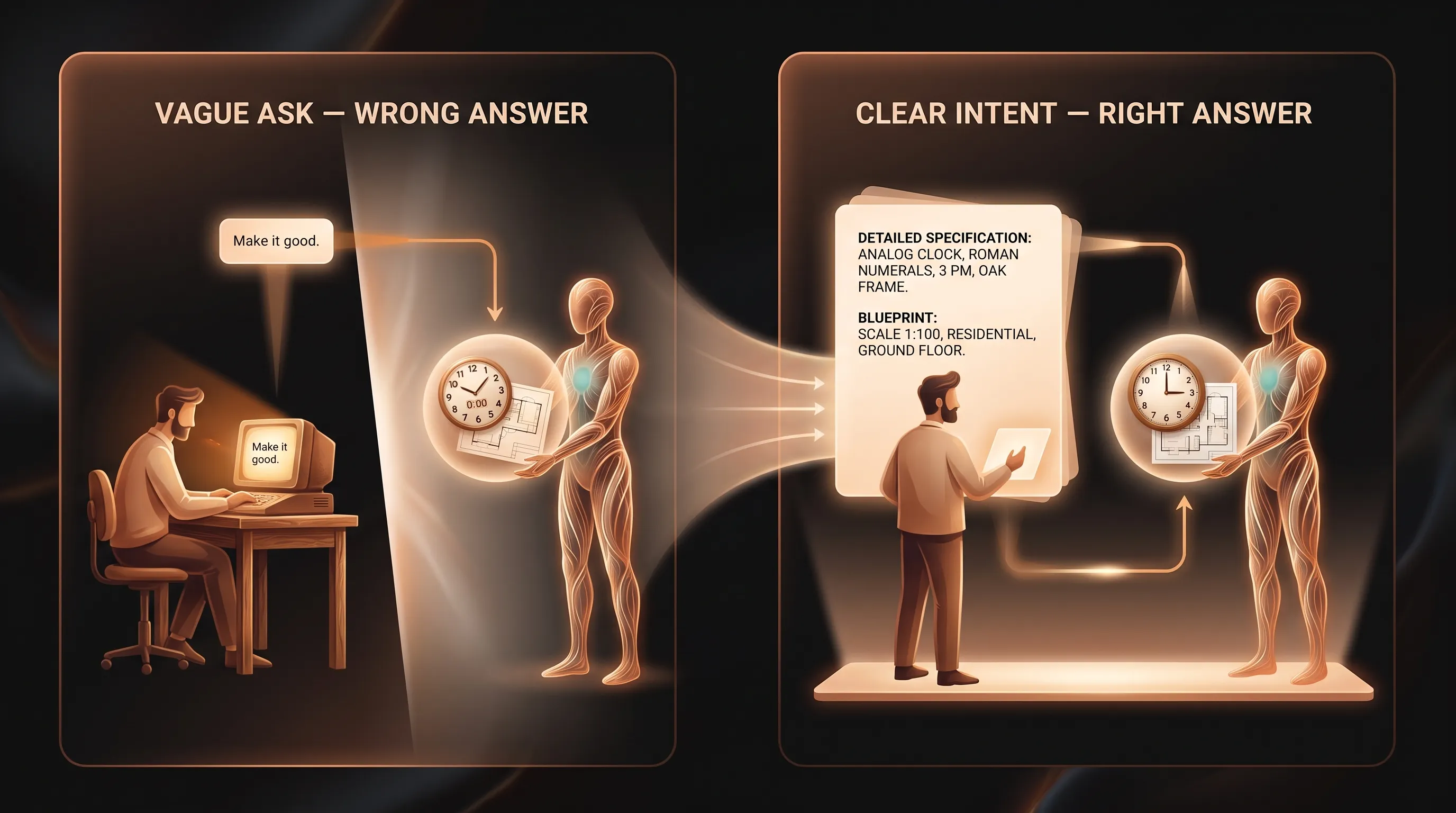
Closing the gap is the actual work
Which is why an AI employee takes real onboarding, not a signup. The onboarding is the work: making your intent explicit and durable, writing the standard down once in a form the machine can act on and you can still check. Do that, and the misses stop being mysterious. They shrink the way a good hire’s mistakes shrink once they’ve learned how you do things.
It’s the same reason we tell owners you stay above the outcome rather than operating the thing yourself, and why the AI employee runs on a brain that remembers your business instead of guessing at it fresh every morning. Both are ways of closing the same gap and keeping it closed.
The distance between what you meant and what the machine heard is the entire job. Close it on purpose and the AI finally does what you wanted. Leave it to chance and you join the 95%.