
When we started building AI employees, we had an assumption that felt obviously right. To teach the AI about a business, you should summarize it. Take the messy pile of calls, emails, and notes, boil it down to a clean one-page brief, and feed it the summary. Tidy input, tidy output.
We tested that assumption, and it was wrong. Summarizing the business first made the AI employee worse at the job.
What a summary throws away
Here’s why, and it’s obvious in hindsight. A summary keeps the headline and drops the detail. But in a real business, the detail is the whole point.
The value isn’t “we take orders.” It’s that this customer always wants it cut a certain way, and that client gets thirty days to pay even though nobody else does, and when someone calls about a leak on a weekend you do this, not that. A summary sands all of that off. It forces the specific, real truth of your business into a generic template, and the generic template is exactly the part any competitor could have written too.
When we summarized first, the AI employee gave answers that sounded right and were generic. When we stopped, it started handling the specific, odd, real cases that make a business yours.
Store it raw
So we changed the architecture. Instead of compressing your business into a brief, we keep the real material: the actual conversations, the actual documents, the way things actually got handled. The AI employee reaches into that raw detail when it needs it, rather than leaning on a thin summary someone wrote once and never updated.
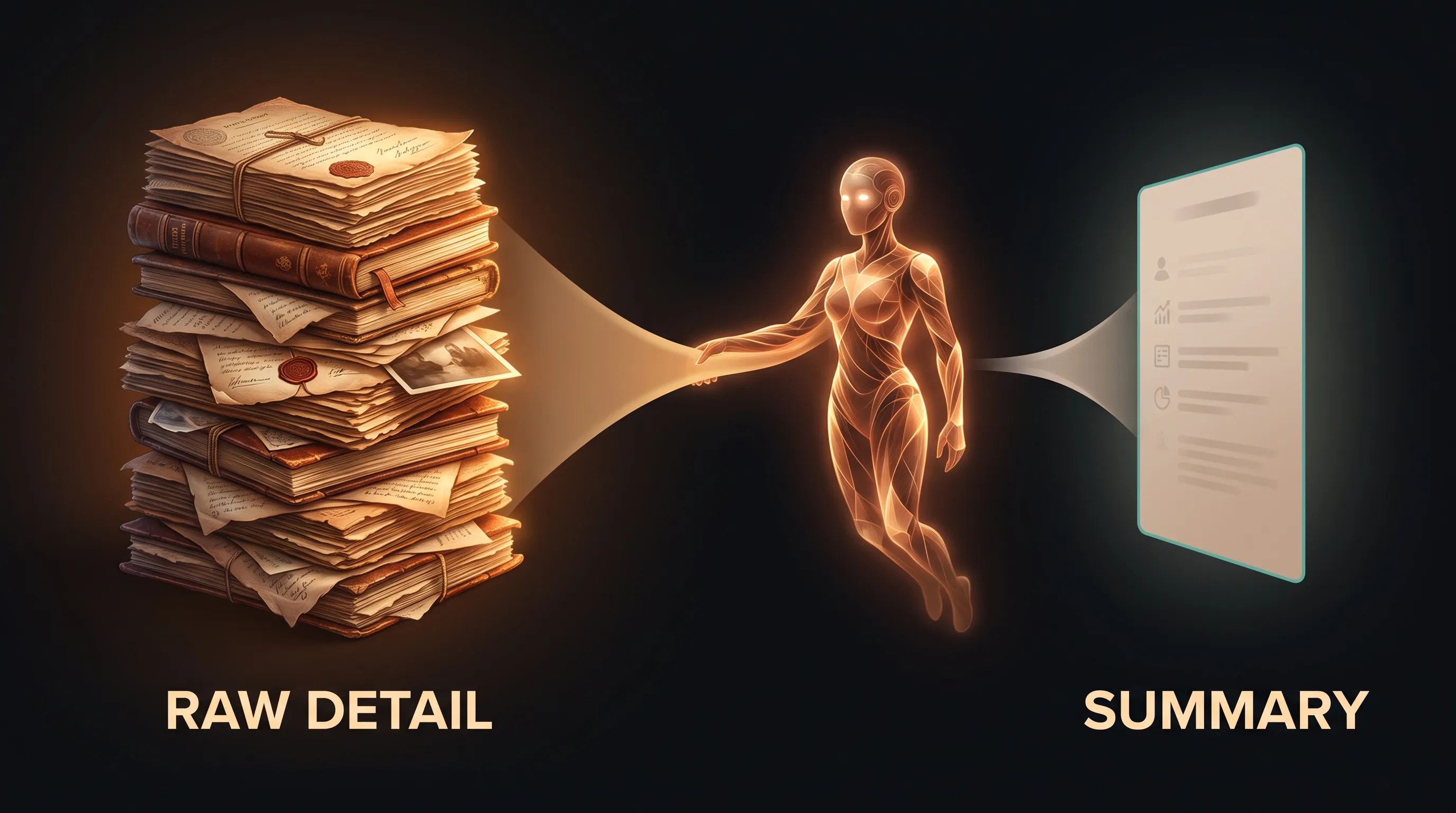
This is part of why we built the Business Brain the way we did, to hold the real thing rather than a tidy abstraction of it. I wrote about that decision in two ideas for an AI’s second brain.
Why it matters for you
For you, the practical upshot is simple. When someone asks you to “just send over a quick summary” so the AI can learn your business, that instinct will quietly make your AI employee more average. The goal isn’t a neat brief. It’s giving the AI employee the real texture of how you work, so it can answer the question a customer actually asks, not the tidy version of it.
The good news is this means less homework, not more. You don’t have to distill your business into the perfect document before an AI employee can help. What it needs is the real material you already have. We wrote about exactly what to bring in what an AI employee needs before day one.
Don’t summarize your business. Hand over the real thing.