
Daniel Miessler wrote something this week that names a shift a lot of owners feel but can’t quite word. “The better AI gets at learning everything about the world, the more it’s going to know how to do average things really well,” he put it. Read that twice, because the second half is the part that changes how you should spend.
If average work is about to be done well by everyone, average work stops being worth much. The premium moves to whatever isn’t average. For a service business, that isn’t a mystery. It’s the stuff only your shop knows.
What “average” is worth now
Most of what a business produces in a day is average on purpose. A standard quote. A routine reply. The fifth version of an email you’ve sent a hundred times. That work has to happen, but none of it is why a customer picked you over the shop down the road.
For years that average work was expensive anyway, because a person had to do it. That’s the part that’s changing. When a good answer to a standard question costs almost nothing to produce, competing on standard answers is competing on a thing that just went to zero.
Your edge was never the average
Think about your best employee — the one you’d least like to lose. What makes them valuable isn’t that they can write a normal quote. It’s the exceptions they carry in their head. The client who always needs the invoice split a certain way. The job that looks routine but has a catch you only learn by getting burned once. The judgment to know when the rulebook doesn’t apply.
That’s the “unconventional” part Miessler is pointing at, scaled down to a business. It’s not genius. It’s the specific, hard-won, slightly weird way your company actually operates. That knowledge is the moat, and it’s exactly the part a generic model doesn’t have, because it was never on the internet to learn.
Capture the exceptions, not the average
Here’s where owners get the move backwards. They try to hand AI the average work by explaining the average, over and over, every session. That’s effort spent teaching a model things it already knows.
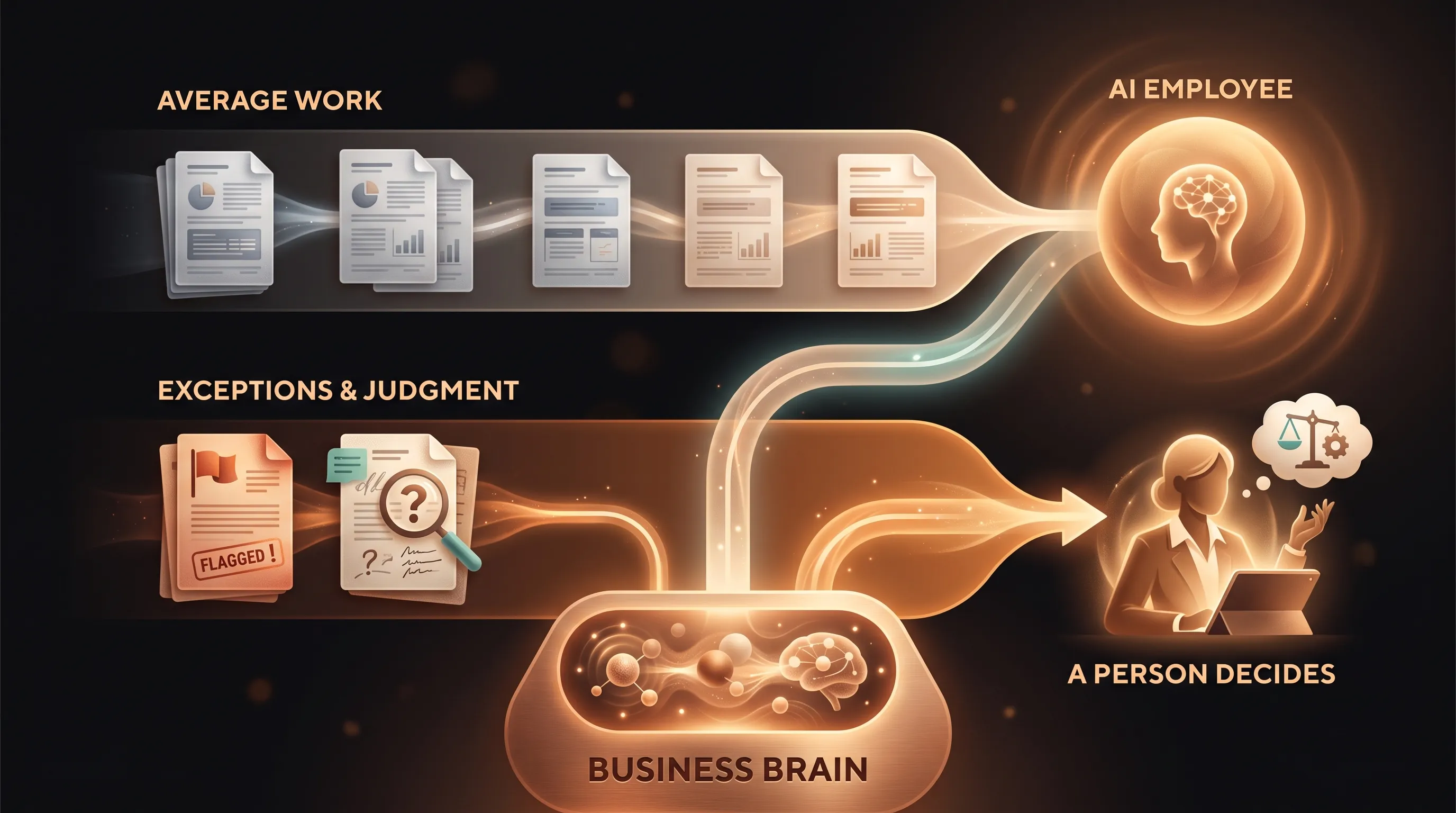
The higher-value move is to capture the part it can’t guess: the exceptions. That’s the whole idea behind a Business Brain — a single place that holds your quoting rules, your standard specs, your client quirks, and the “we always do it this way” that used to live only in one person’s memory. An AI employee reads from that before it answers, so the routine work comes out sounding like your shop, not like the average of every shop.
A quick test for what belongs there: if a stranger with a good general assistant could produce it, it’s average, and it isn’t your edge. If it takes knowing your business, capture it.
Spend your people where average can’t reach
Once the average work is handled, the math on your team changes. The scarce resource stops being hours and starts being judgment. You want your best people on the exceptions, the odd calls, the customer who needs a human — not grinding through the standard pile because nobody else could.
That’s the quiet promise of doing this right. An AI employee takes the average, which is now cheap, and gives you back the hours to spend on the part that was never average and never will be. If you want the mechanics of why an AI employee can hold your specifics where a chat window can’t, we wrote about that in what a managed AI employee actually is.