
A client’s auto policy comes up for renewal on a Tuesday. It’s not a hard save. She’s been with your agency four years and has never once complained. The renewal just needs a touch: a quick call, a check that nothing’s changed, a nudge before the deadline. But the producer who owns her is heads-down closing new business, the reminder is a note in a spreadsheet nobody opened, and the date slides past. Three weeks later she’s with the agency that called her first. You didn’t lose her to a cheaper quote. You lost her to silence.
That’s the quiet way agencies bleed. It isn’t a lead problem, it’s a follow-up problem: known, winnable revenue dying in an inbox. And the data says it’s exactly how clients leave. 65% of clients who leave an agency never speak to anyone before they go, though 80% of the ones who do have a conversation stay. Against an industry retention rate that averages around 84% while the best agencies hold 93 to 95%, every silent lapse is book value walking out the door. So let’s walk through that Tuesday renewal the old way, then what changes when an AI employee owns follow-up.
The old way
The renewal date lands on a Tuesday. Here’s how it plays out:
- The reminder lives in a spreadsheet, a calendar nobody checks, or a producer’s memory. Running the book on memory is driving at night with no speedometer.
- Everyone’s busy with new quotes, because new business feels like growth and a renewal feels like it’ll take care of itself.
- The deadline passes quietly. There’s no alarm for the thing that didn’t happen.
- A competitor’s mailer or call reaches her first, she realizes nobody from your side checked in, and she moves.
- Nobody logs it as a loss. On paper it’s just one policy off the book, buried in a retention number that drifts down a point a year.
None of this is negligence. It’s what happens when follow-up depends on someone remembering, in a week already full of people who called first. The trouble is that the client you already earned is the cheapest revenue you’ll ever have, and it’s the one nobody’s scheduled to protect.
The AI employee way
Same Tuesday renewal, except the agency has an AI employee named Dana working the book. Dana has read the agency’s Business Brain, so she knows the renewal calendar, the carriers, which producer owns which client, and what a good pre-renewal touch sounds like in the agency’s voice.
Here’s the same month:
- Dana watches every upcoming renewal and reaches out well before the date, not the morning it lapses, by call, text, and email.
- She confirms nothing’s changed, flags anything that needs a producer, and re-quotes where it makes sense, so premium surprises don’t become exit ramps.
- A client who sounds unsure she routes straight to the right producer with the full history, so a human handles the save while it’s still savable.
- She works reactivation too, the lapsed and long-quiet clients nobody has time to chase, instead of only the inbound.
- Every touch logs automatically, so the book stops depending on who remembered what.
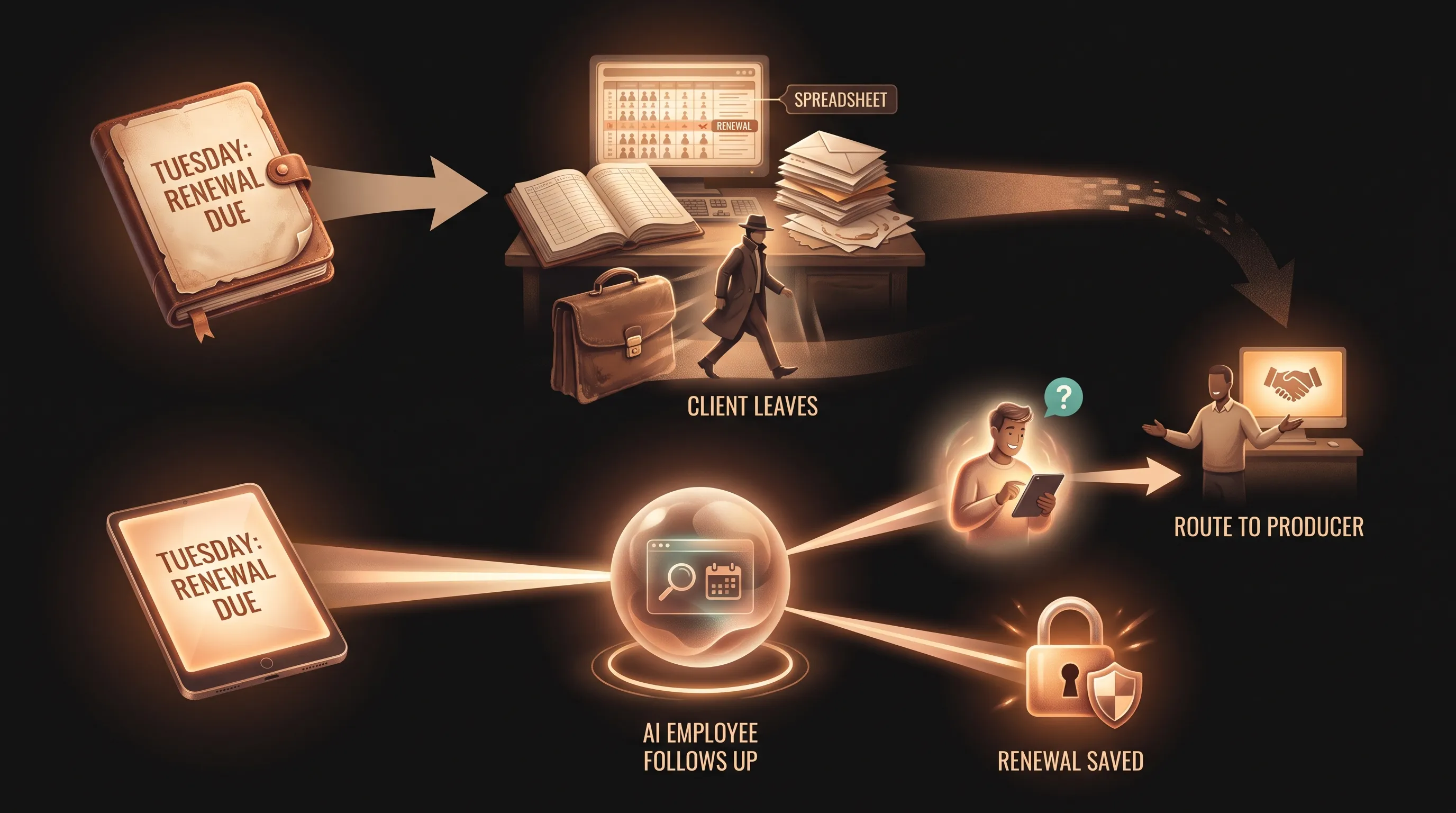
The renewal never lapses in silence. The client never discovers that nobody checked. And the producers spend their time on the saves and quotes that need a human.
Why the tools you tried didn’t do this
Most agencies already have a management system with a renewals report. The report is real; the problem is that reading it and acting on every line is a job, and it’s the first job to slide when the week gets loud. A reminder that pings a busy person isn’t follow-up. It’s a to-do that competes with forty others.
Dana works because of what sits behind her: a Business Brain built from how your agency actually runs its book. That’s the piece the reminder was missing. It doesn’t just surface the renewal, it does the touch. And she compounds, because retention compounds: a 5% lift in retention held for five years can double an agency’s profit.
Renewals are the right place to start for one plain reason: this is revenue you already won, so saving it is cheaper than chasing anything new. It’s the same speed-and-follow-up gap that costs businesses their freshest leads, just moved to the client you already have. Work every renewal, route the ones that need a person, and the book stops leaking a point at a time.