
The bottleneck in a busy accounting season is rarely the accounting. The returns aren’t what pile up. The waiting is. A firm can’t finish work it doesn’t have the documents for, so half of tax season is really one exhausting job: getting clients to send the things they said they’d send.
That job is bigger than it looks, and it lands on the people you can least afford to burn out. Accounting professionals spend an average of 9.3 hours a week on client communication, much of it chasing. Chasing is so baked into the work that 94% of firms do it just for late payments, before you count the document follow-ups. And it takes a toll: 99% of accountants report some level of burnout. So let’s walk through the document chase the old way, then what changes when an AI employee owns it.
The old way
A client engagement kicks off in February. Here’s the next six weeks:
- A staff accountant sends the document request, a long list, and waits.
- Nothing comes back. A week later they send a reminder, digging through email to remember who’s still outstanding and for what.
- The client sends half the list and forgets the rest. Now someone has to notice which pieces are missing and ask again, specifically, for those.
- A spreadsheet of who-owes-what is supposed to keep it straight, except keeping the spreadsheet current is itself a job nobody has time for during season.
- The return sits half-built, blocking the schedule, while the same three clients get the same three emails nobody enjoys sending.
- April arrives and the crunch isn’t from doing the work. It’s from all the work that could only start once the documents finally showed up.
Every step is a competent person doing necessary follow-up. Stacked across a whole client book, it becomes a full-time chase that produces no billable output and quietly drains the team.
The AI employee way
Same February, except the firm has an AI employee named Cora running document collection. Cora has read the firm’s Business Brain, so she knows each client’s required document checklist, the filing deadlines, the engagement letters, and the firm’s voice.
Here’s the same six weeks:
- Cora sends every client their personalized document request, tracks exactly what’s outstanding, and updates the status the moment anything arrives.
- When a client sends part of the list, she notices precisely what’s still missing and asks for just those items, by name, instead of resending the whole request.
- She follows up on her own cadence, politely and persistently, in the firm’s voice, so no client goes quiet for a week because everyone was buried.
- The live picture of who’s blocking what is always current, so partners can see the real bottlenecks instead of reconstructing them from a stale spreadsheet.
- The judgment calls, a client dispute, an unusual document, a sensitive situation, she flags to a human with the history already assembled.
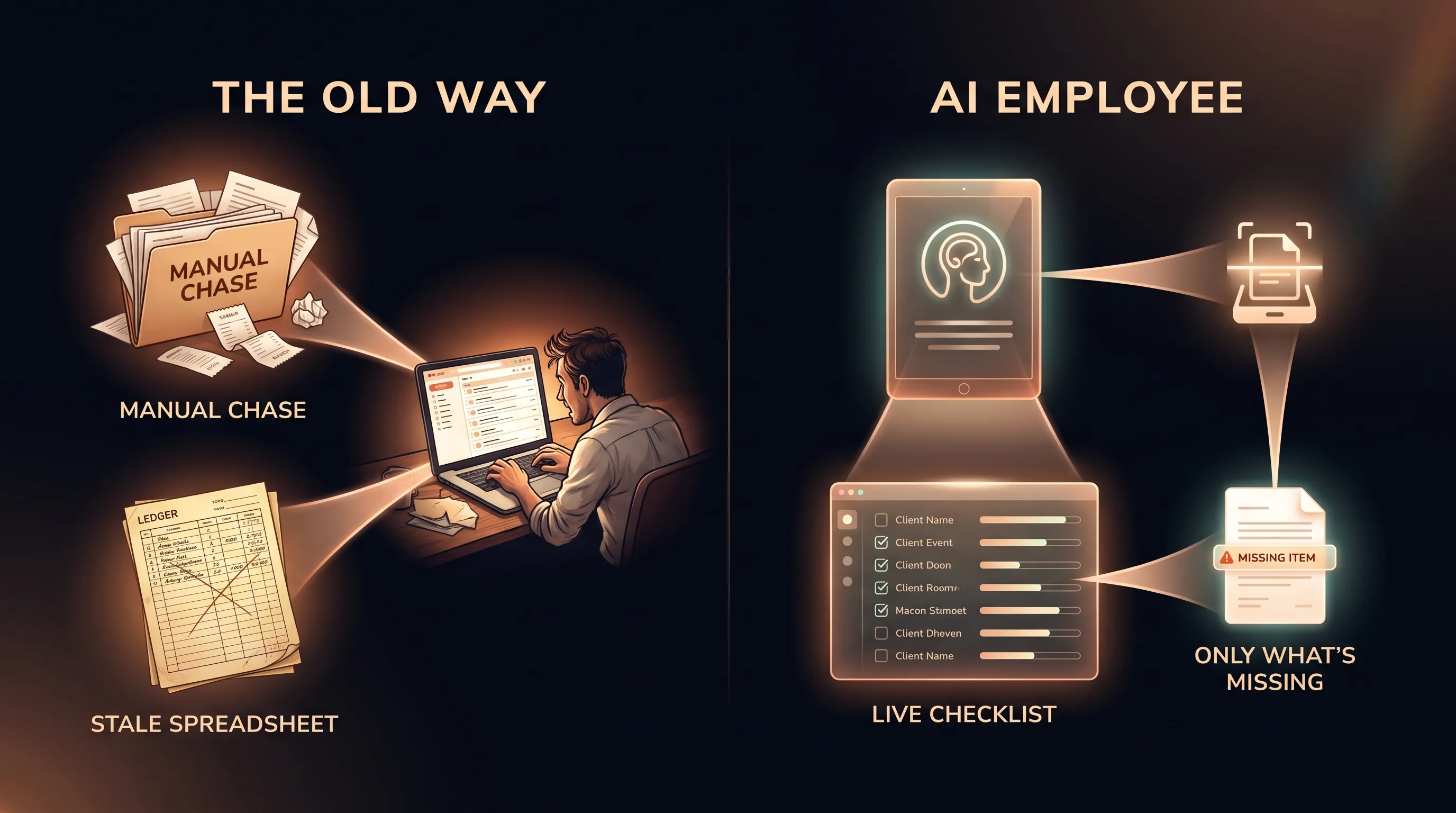
The documents come in faster. The staff stops spending season on emails nobody wanted to send. And the crunch shrinks, because work starts when the client’s file is complete instead of waiting on a follow-up someone was too slammed to send.
Why the tools you tried didn’t do this
Most firms already have a portal with reminder features. It sends the same generic nudge to everyone and doesn’t know that this client always forgets their brokerage statements or that that one only responds to a phone call. So clients tune it out, and the staff goes back to chasing by hand.
Cora works because of what sits behind her: a Business Brain built from how your firm actually runs its engagements. That’s the piece the portal was missing. It’s also why she gets sharper each season, learning which clients need which nudge and when, until she chases the way your most organized manager would if they had nothing else to do.
Document collection is the right place to start for one plain reason: the time is measurable and the relief is immediate. Professionals expect AI to hand back around four hours a week now, rising to twelve within five years, and the chase is exactly the kind of repetitive follow-up that frees. Take it off your team’s plate and season stops being defined by the documents that hadn’t arrived yet.