
Every AI vendor has a case study with a big number in it. A logo, a testimonial, a “3x more leads.” It costs nothing to write and proves almost nothing, because in a market where anyone can generate a convincing demo in an afternoon, a polished story is the cheapest thing on the table. The question that protects you isn’t “who has the best case study.” It’s “will you run this on my business, in front of me, before I pay you a dollar?”
That’s the shift worth understanding. Attention used to be the game: win the click, tell the story. Now the buyers who don’t get burned are the ones who demand proof they can watch happen.
The demo is the easy part, and the market knows it
The gap between a great demo and a working system is where most AI money dies. Gartner expects 30% of generative AI projects to be abandoned after the proof of concept, and MIT found 95% of enterprise AI pilots delivered no measurable return. A demo clears a bar that production never does. So a case study describing someone else’s demo, dressed up as a result, tells you very little about whether the same thing will survive contact with your actual work.
Buyers have caught on. In a 2026 survey of more than a thousand B2B decision-makers, 94% now fact-check AI-generated research, and vendor marketing collateral ranked dead last among the sources they trust. The case study isn’t persuading the room anymore. It’s being quietly checked against reality.
Third-party proof versus proof you can watch
There are two kinds of proof, and they’re not close in value.
The first is third-party proof: a revenue figure, an exit, a glowing quote. It’s said once, it’s easy to claim, and it happened somewhere else to someone else. The second is real-time demonstration: expertise applied to a real problem, live, where you can see the mechanism work. That one is hard to fake, which is exactly why it’s the only proof that means anything now. Watching a hundred people cross the ice tells you more than a testimonial about the crossing.
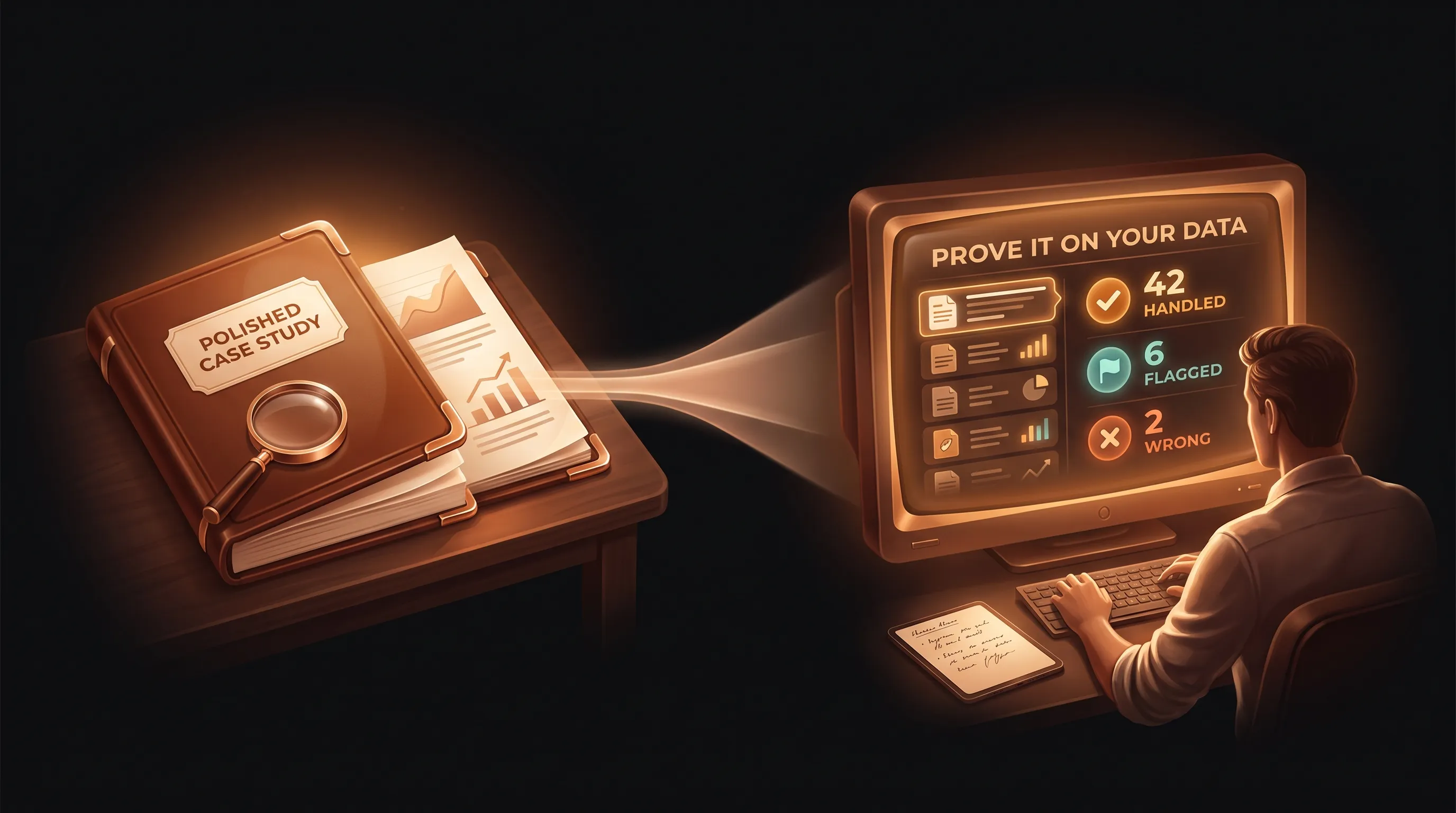
For an AI employee, real-time proof has a specific shape: take a stack of the buyer’s own past work, last month’s calls, the old maintenance requests, a batch of real leads, run them through the AI employee, and show the score. Not “it works.” It handled 42 of these 50 correctly, flagged 6 for a human, and got 2 wrong. Here’s exactly where, and here’s how we’d fix it. A vendor who won’t do that is asking you to trust the brochure.
Why we’d rather show you than tell you
This is why our whole model runs on a live look at your business instead of a deck. A generic assistant will happily generate a plausible answer about work it’s never seen; the honest test is whether it holds up on the messy, specific reality of your operation: the edge cases, the exceptions, the things your best employee just knows. That’s the part a case study can’t show and a live run can’t hide.
So take the case studies for what they’re worth, which isn’t much, and apply the same standard to us. Before you commit, make any vendor prove it on your data, with your edge cases, where you can see the misses as clearly as the wins. It’s the same instinct behind everything we’ve written about hiring an AI employee without getting burned: in a year of show-me instead of tell-me, the proof isn’t in the pudding. The proof is the pudding.